A home conceived as a setting for entertaining asks different questions of design than one shaped purely by everyday domesticity. Scale has to do more work, materials must hold attention across long sightlines, and the plan needs to negotiate between openness and privacy without reducing circulation to a series of transitional passages.
Set within a 2,200 sq. ft. apartment in GK1, Delhi, Residence 222 by IndiHaus Design transforms a generic builder-floor 4BHK into a more expansive 3BHK anchored by a central dining volume. Designed as a second home and a space for hosting, the project is led by principal architect Nikita Jain, with Chaitanya Gaur on the design team. Through a vocabulary of arches, columns, and a layered material palette, the apartment privileges scale, depth, and reflection, creating an interior that feels at once theatrical and composed rather than overtly ornamental.
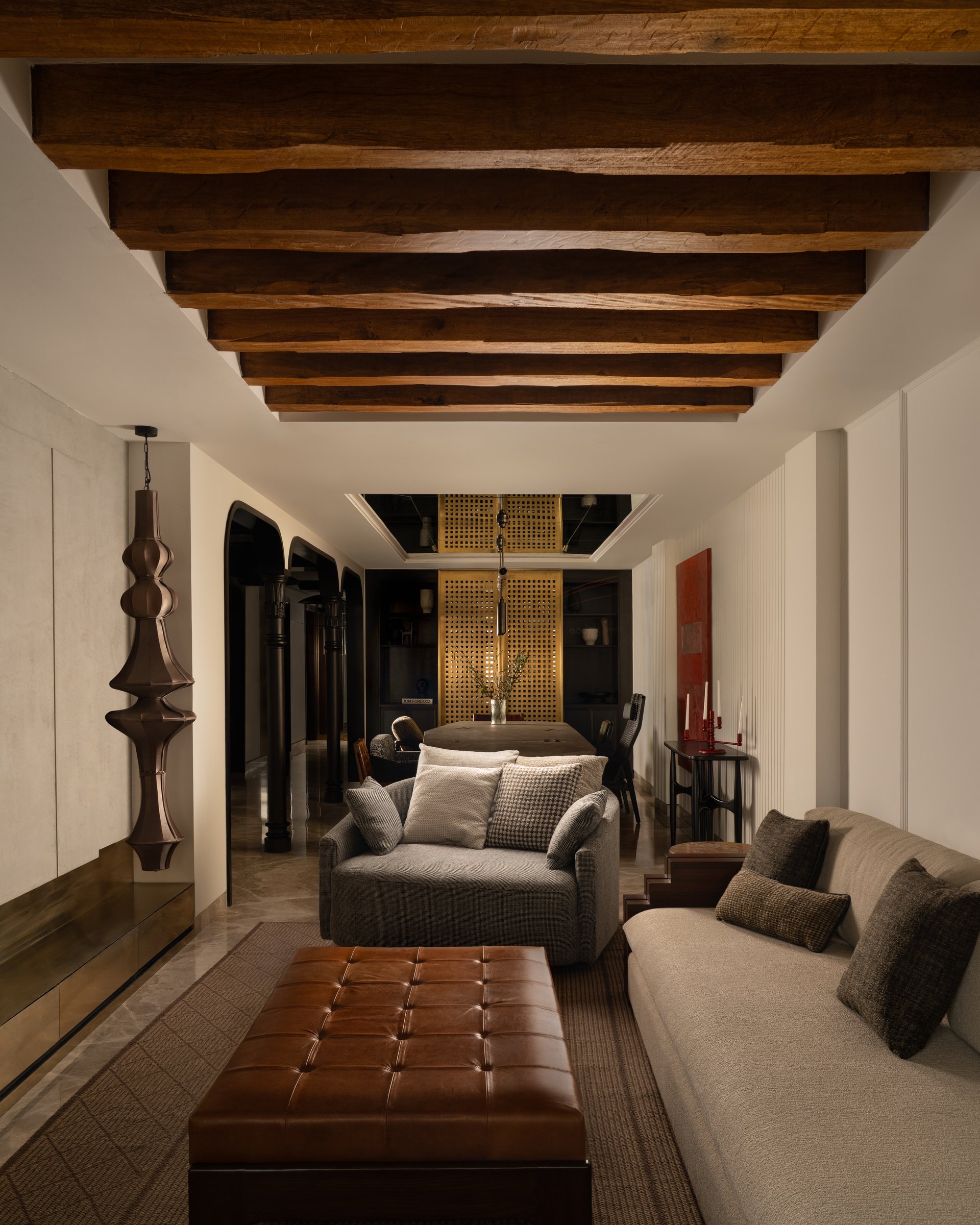
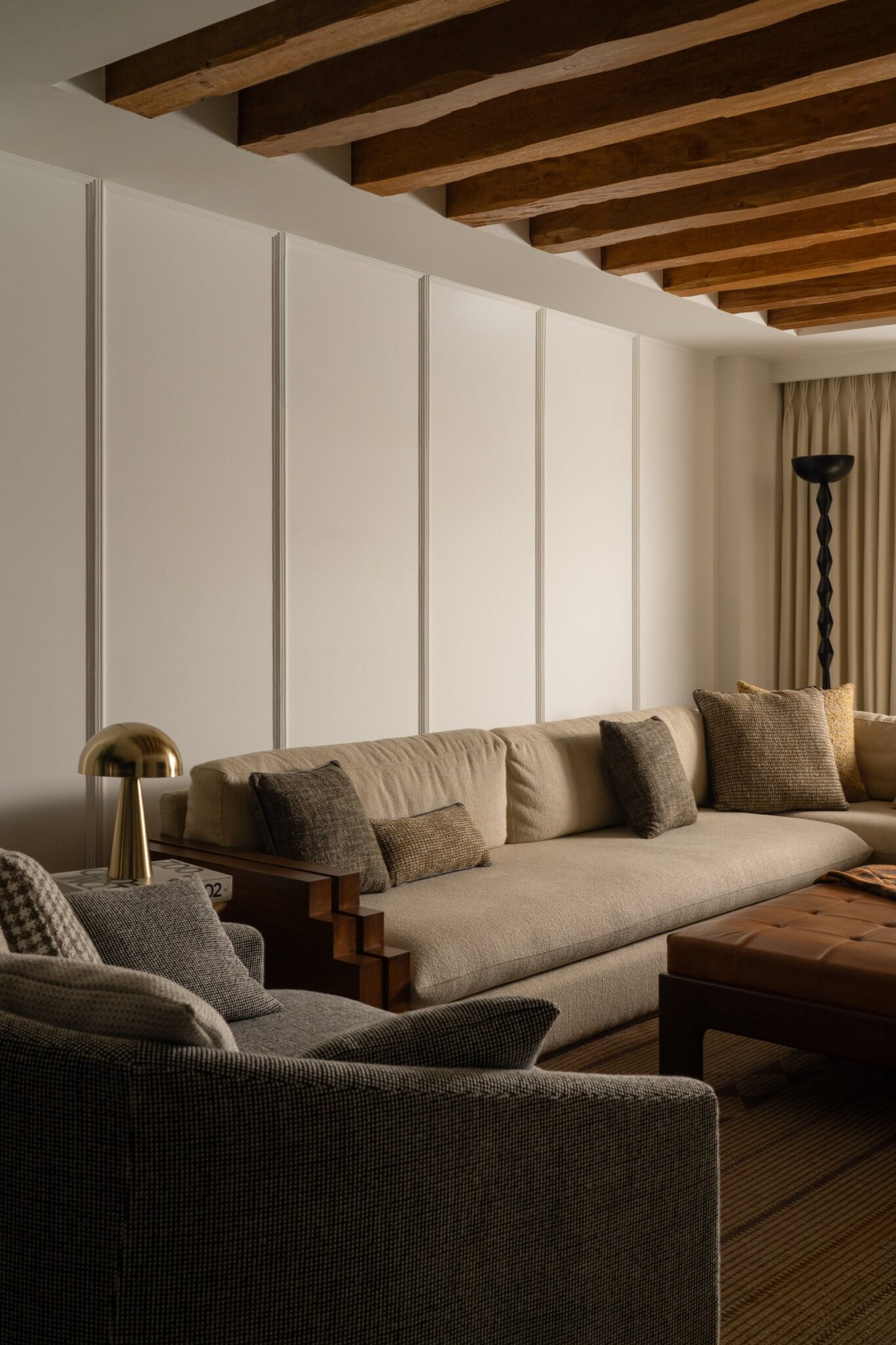
The living room unfolds within a snug, beam-ceilinged volume, opening through a broad arch into the dining space beyond. A linen-toned sectional and a deep-buttoned leather ottoman ground the room, while a sculptural metallic pendant hangs against a pale plaster wall to one side. The composition captures the home’s preference for singular, oversized gestures, where scale and form carry the visual weight rather than an excess of decorative detail.
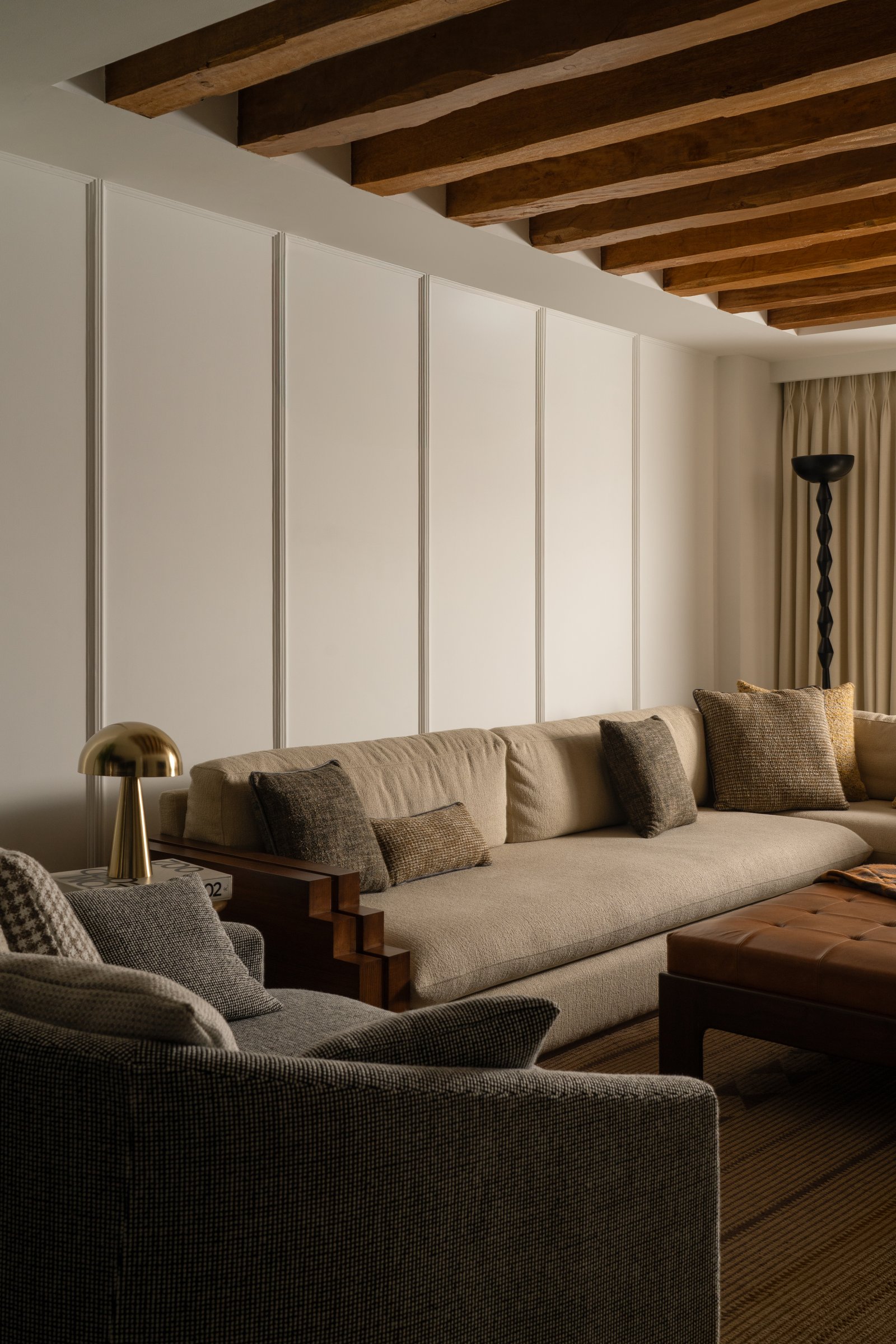
Above the seating, hand-hewn wooden rafters bring the ceiling plane lower, lending the room a tactile intimacy that tempers its overall scale. Behind the sofa, a vertically panelled wall articulated with slim mouldings provides a composed backdrop for the long, low sectional, allowing the brass table lamp and a single dark floor lamp to register as measured accents rather than competing elements.
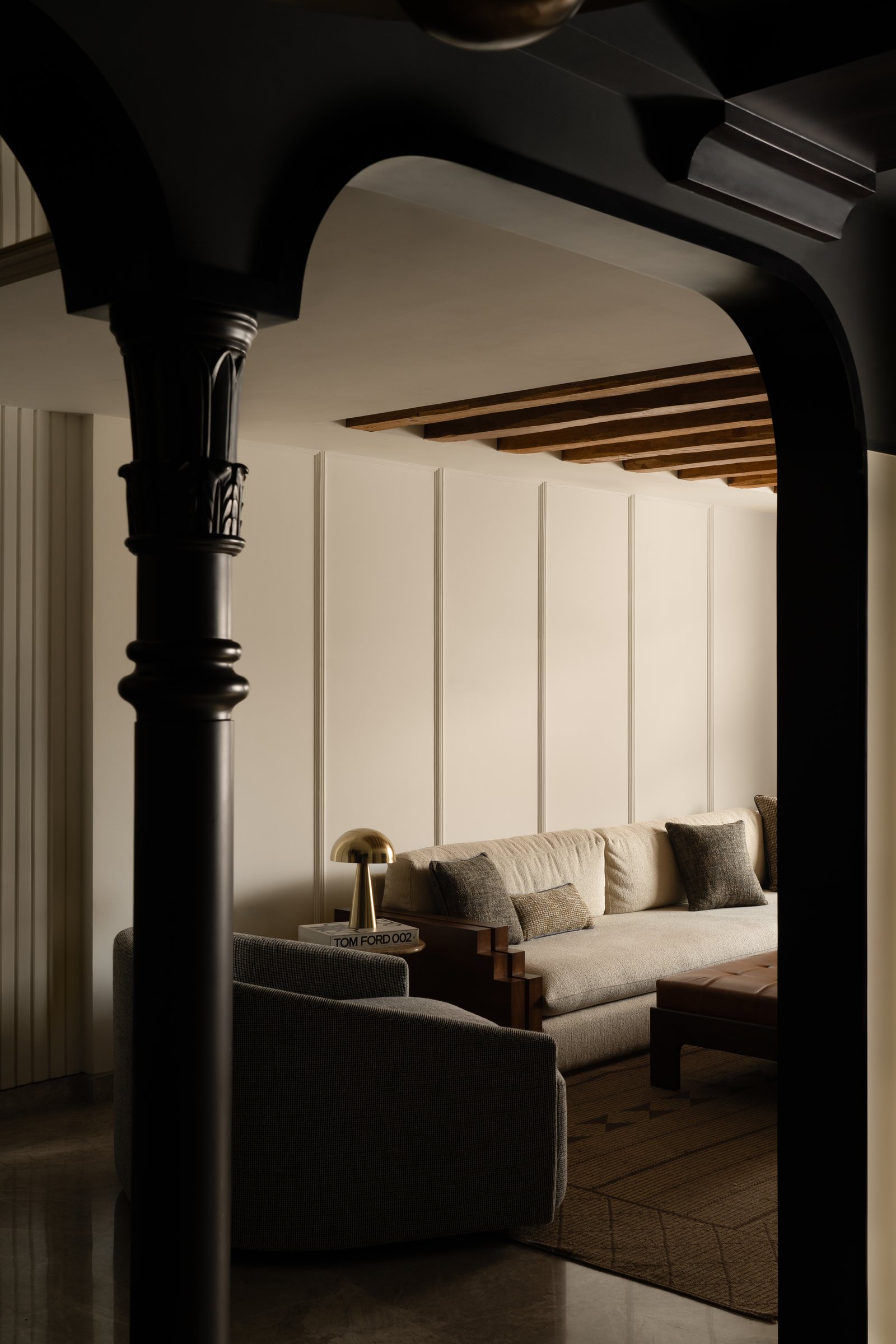
Seen through one of the home’s defining black arches, the living room shifts register, framed by a carved column whose capital references a classical vocabulary rendered in matte black. The dialogue between the dark, ornamented structural elements and the pale upholstered seating beyond gives the room its compositional tension, a quiet conversation between weight and softness.
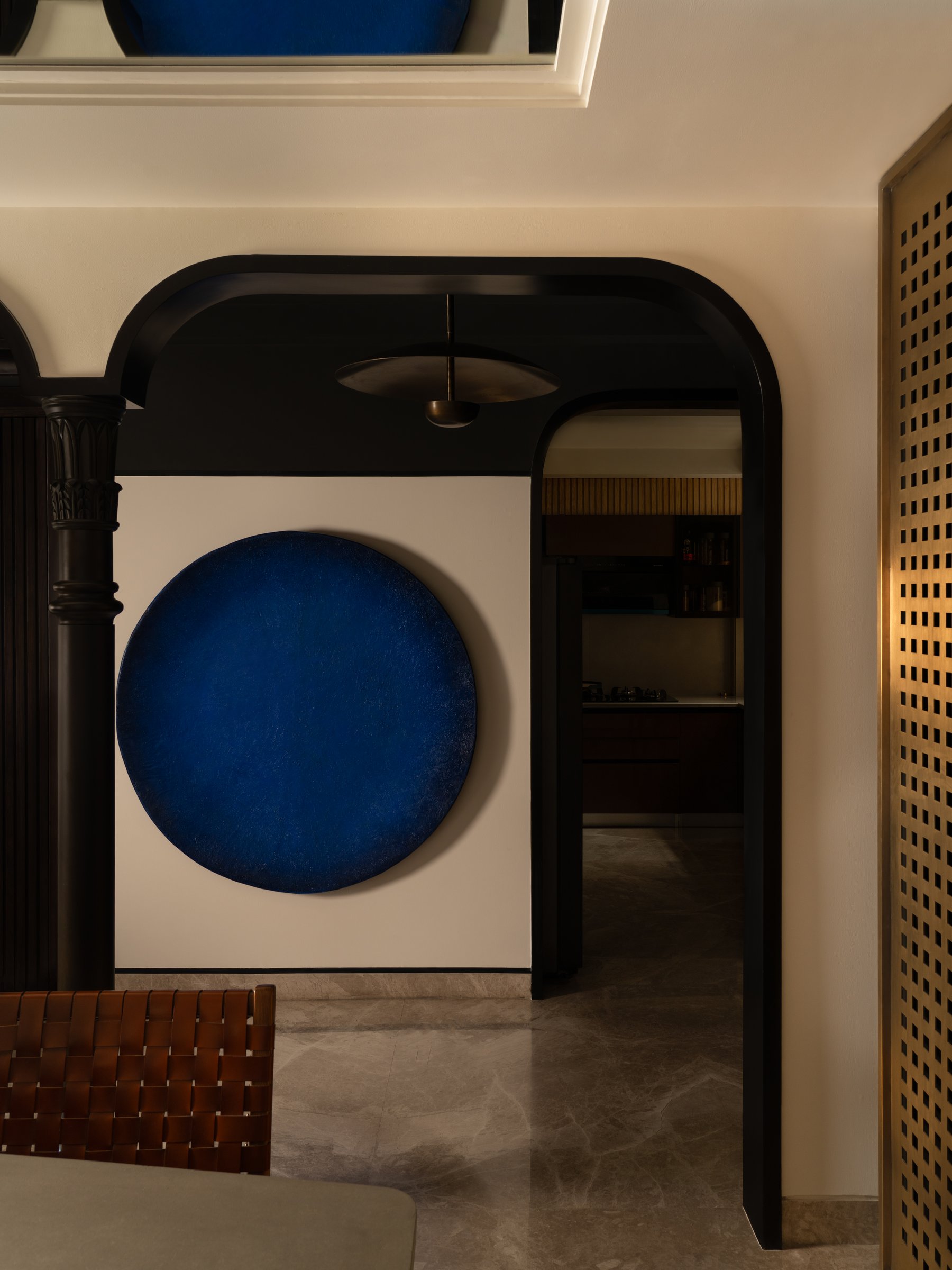
The transition between social zones is articulated through a deep blackened archway, against which a large circular artwork in saturated blue by Mayank Goyal anchors the wall. To one side, a brass perforated screen filters light into the dining beyond; together they establish the home’s reliance on a few decisive, oversized gestures to do the work of an entire decorative scheme.
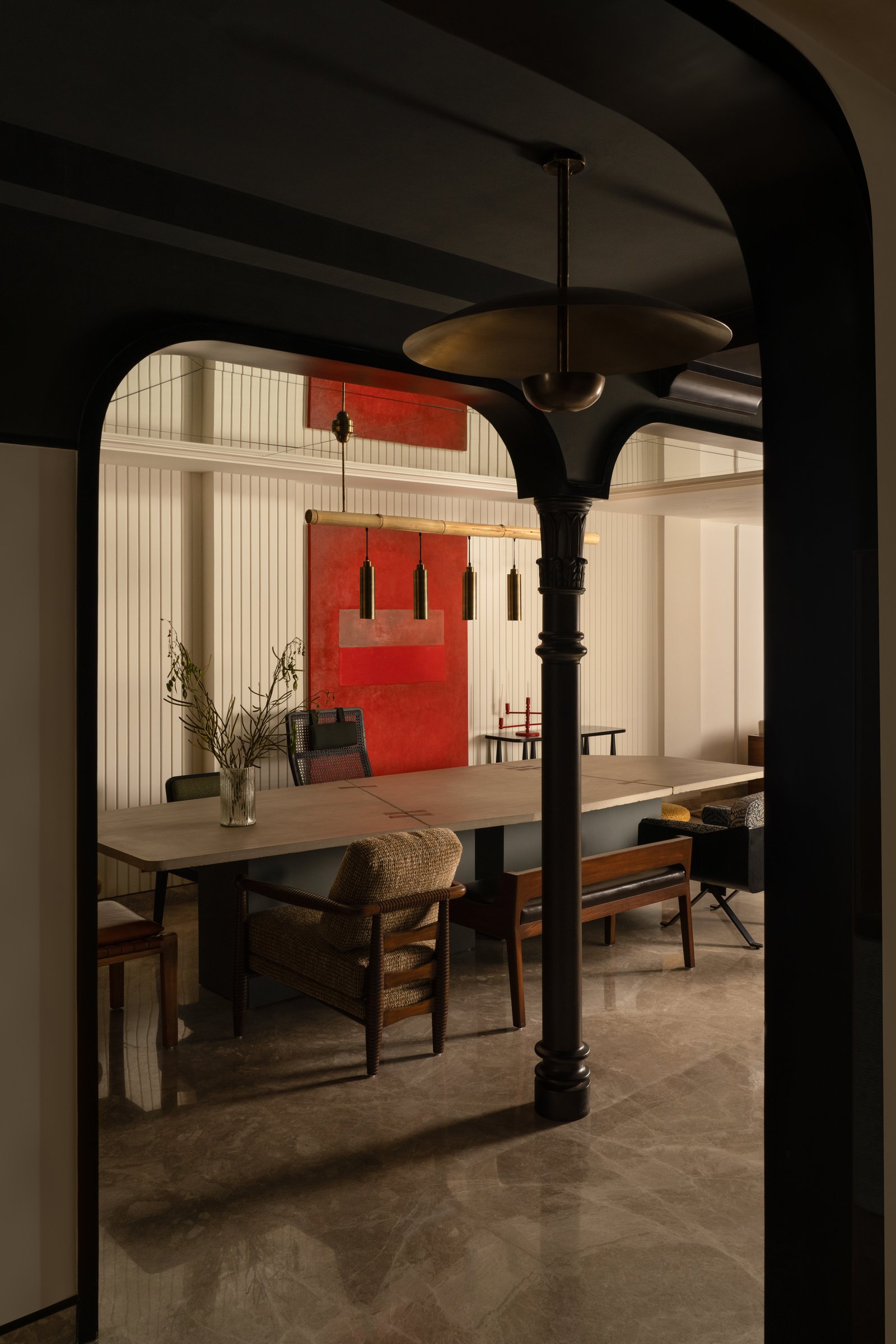
The dining area, conceived as the heart of the home, is set under a darkened ceiling that absorbs the room’s edges and concentrates attention on the long concrete table at its centre. A four-metre slab assembled in sections, its raw edges and inlaid joinery sit beneath a bamboo-and-brass linear pendant, with a red abstract canvas behind reinforcing the room’s theatricality.
““The planning revolved around opening up the dining area as the true heart of the home, creating a central volume around which the social and private spaces unfold.””
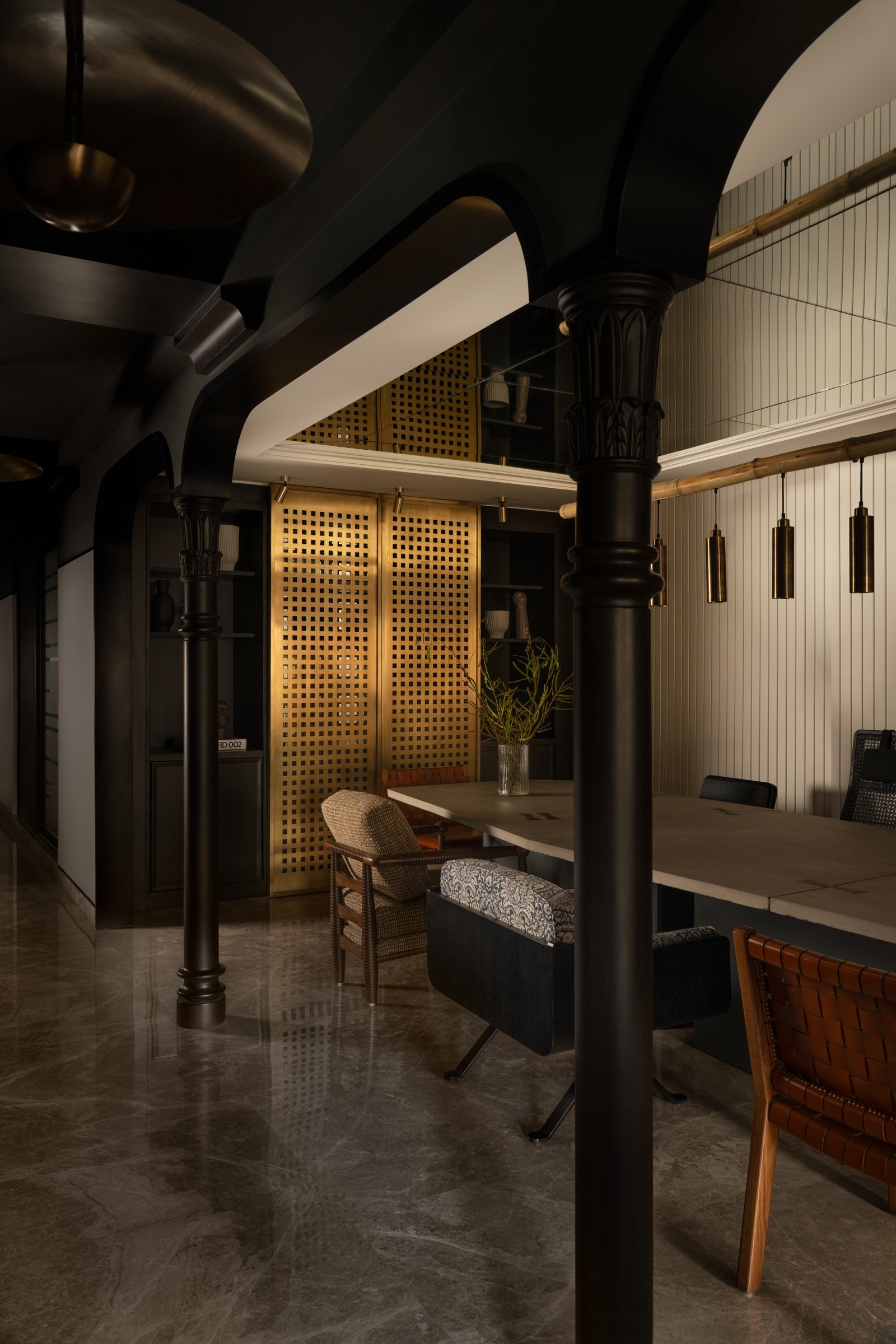
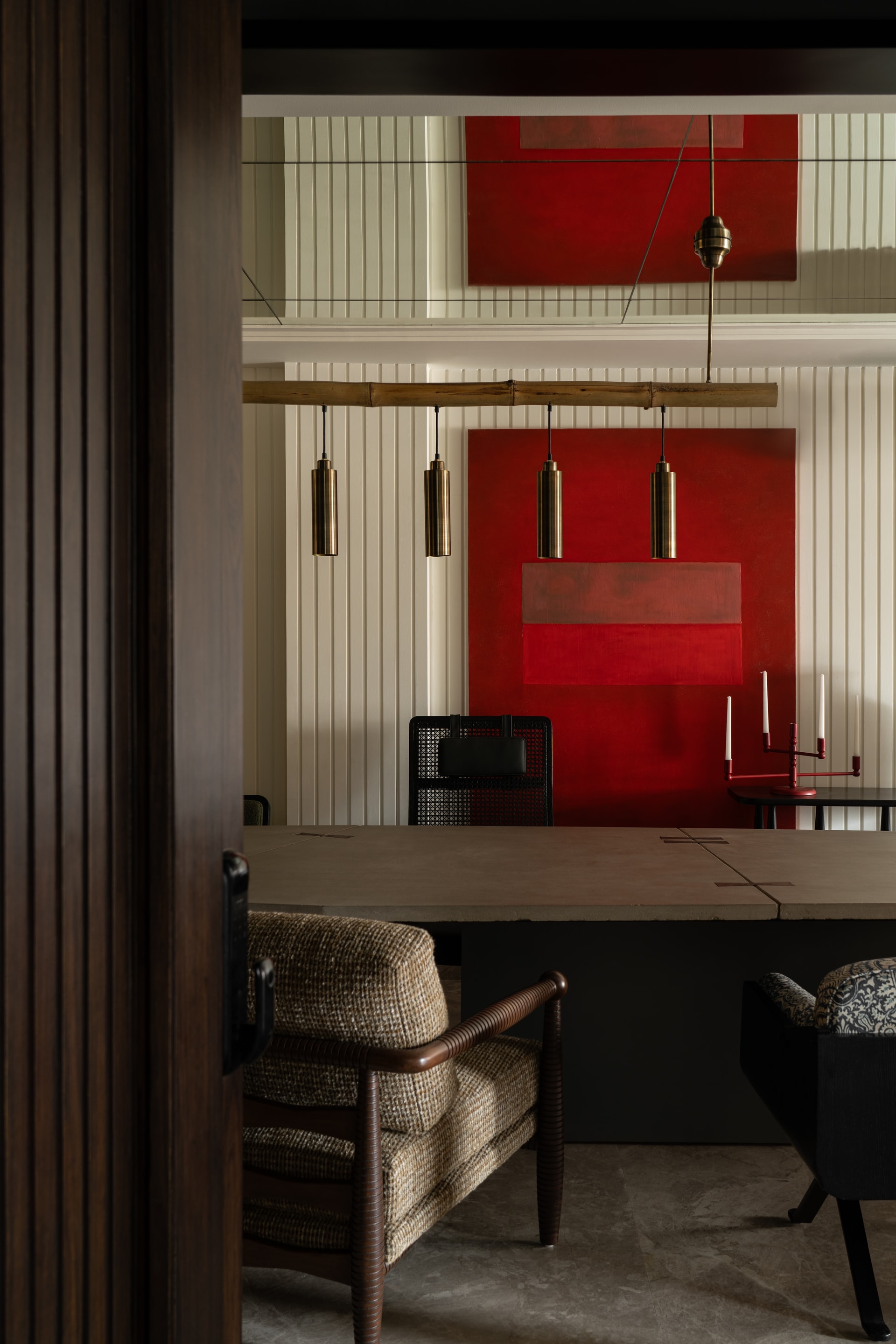
The room’s structural language becomes clearer at closer range: blackened columns with carved capitals frame the table, their classical silhouettes acting as both ornament and structure. The perforated brass screen behind, illuminated from within, glows against the surrounding darkness and conceals the bar that shifts from daytime storage to evening display, while a chair upholstered in woven tan leather brings a craft-led counterpoint to the otherwise architectural palette.
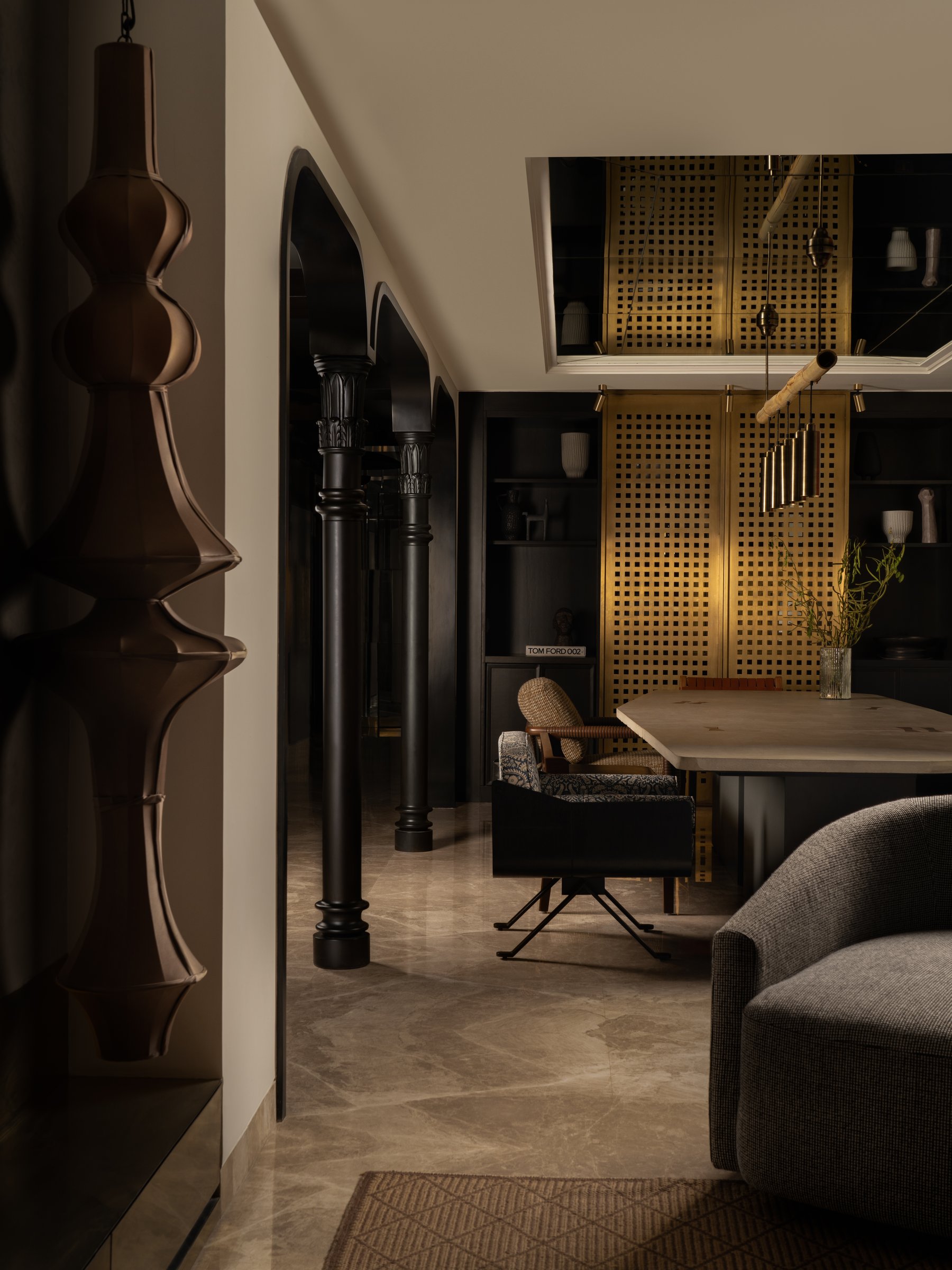
From the threshold between zones, the home’s layering reveals its larger logic, a procession of arches, columns and reflected surfaces that compress and release the eye in turn. The mirrored ceiling above the dining doubles the brass screen and the bamboo pendant overhead, lending a quiet monumentality to a room that is, in plan, relatively compact.
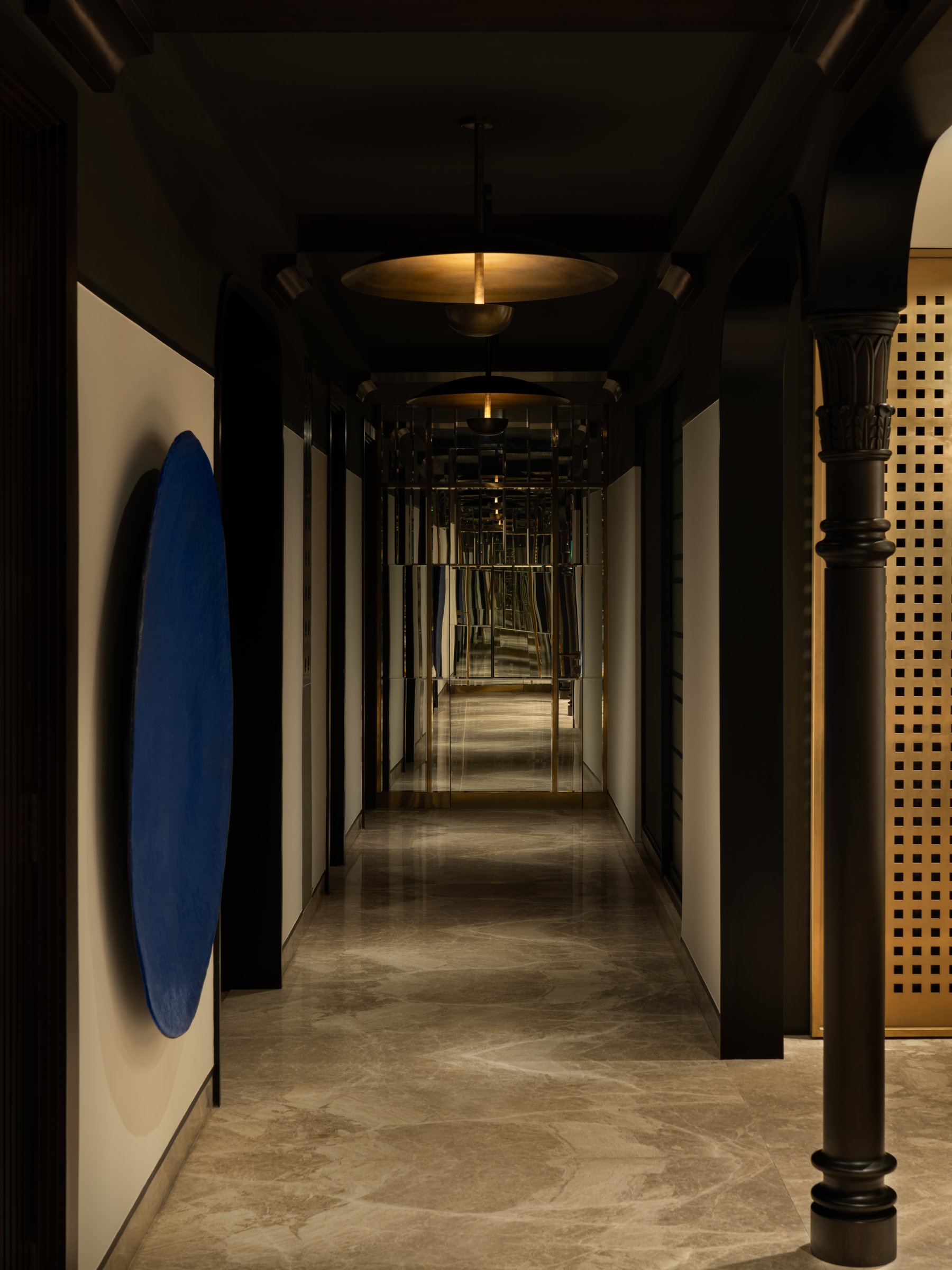
The corridor functions as the spine of the apartment, its charcoal ceiling and brass-toned pendants drawing the eye toward bedroom doors clad in mirror mosaic at the far end. The circular blue artwork reappears on one wall, anchoring the length of the passage and converting circulation into a moment of pause, a curatorial decision that turns wayfinding into experience.
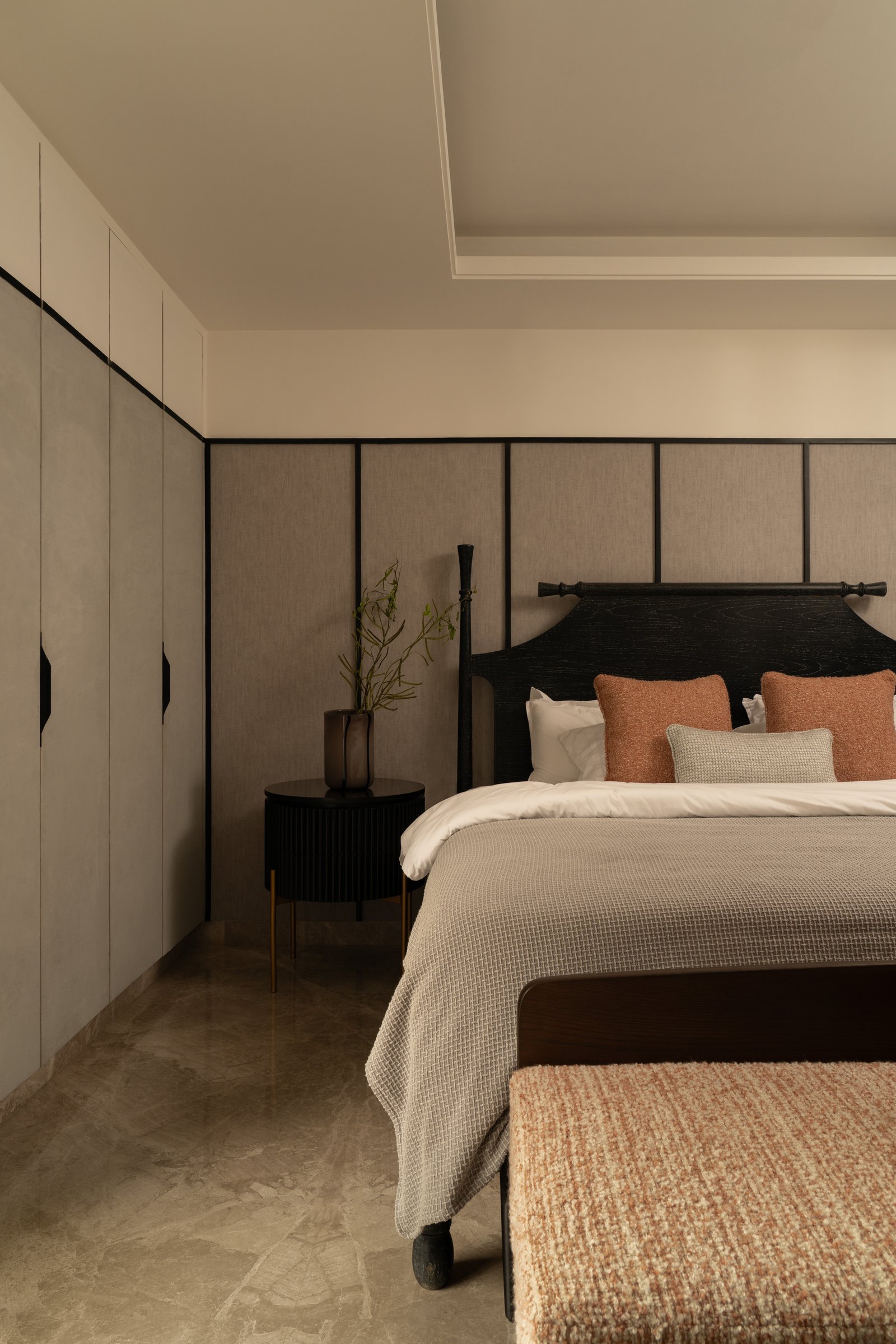
The master bedroom retains the project’s interest in scale but shifts into a softer register, with a fully upholstered headboard wall in muted grey bordered by thin black reveals. A dark wooden bed frame, fluted bedside cabinet and a textured bench at the foot ground the room in a warmer material palette, while terracotta-toned cushions introduce a single accent without disturbing the room’s restraint.
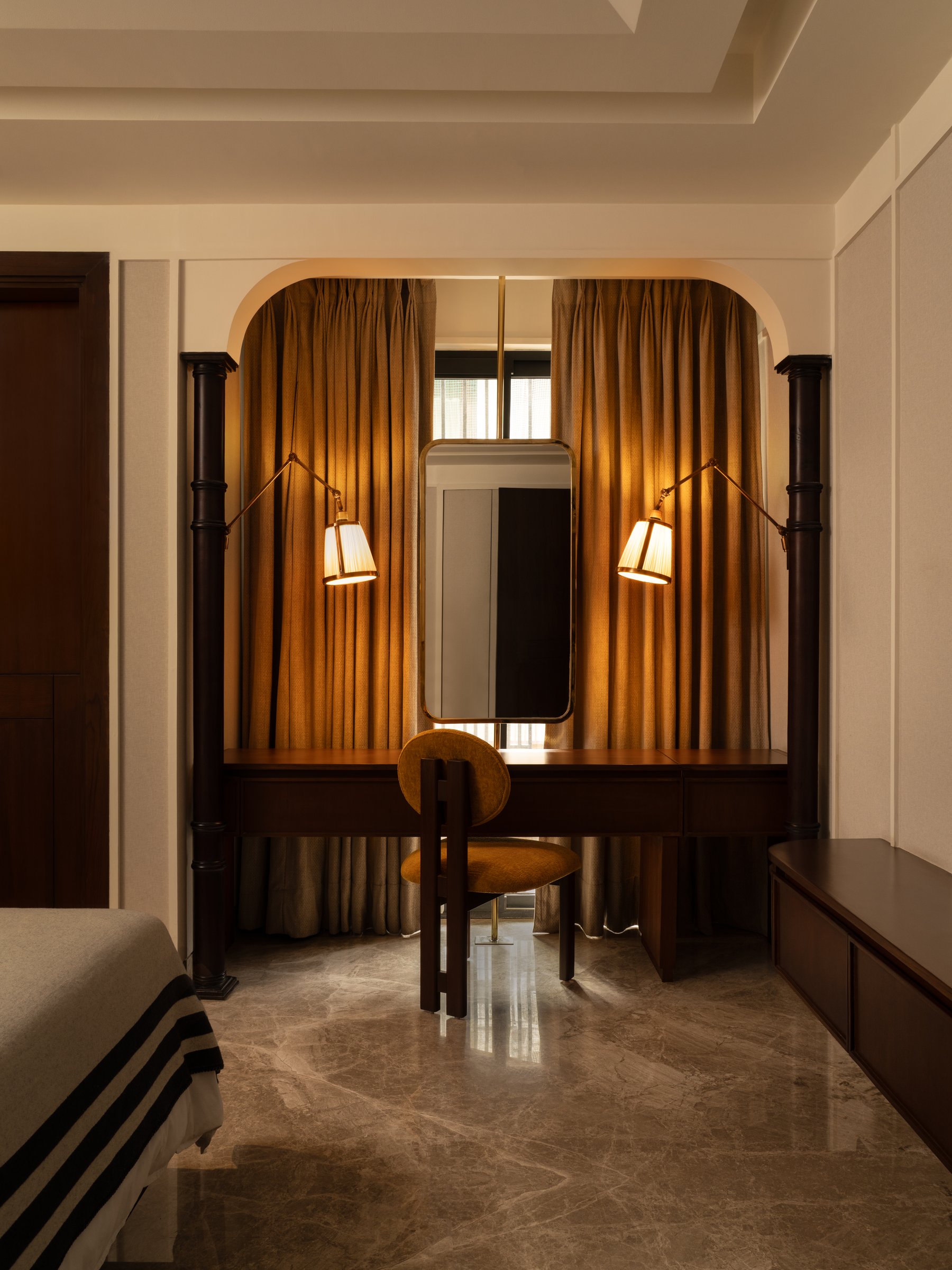
A dressing nook set into the bedroom wall is framed by a pair of slim dark columns and curtained behind in pleated fabric, with twin articulated wall lights flanking a brass-edged mirror above a wooden console. The arched recess treats a functional vanity as an architectural event, a small gesture of theatre folded into private routine.
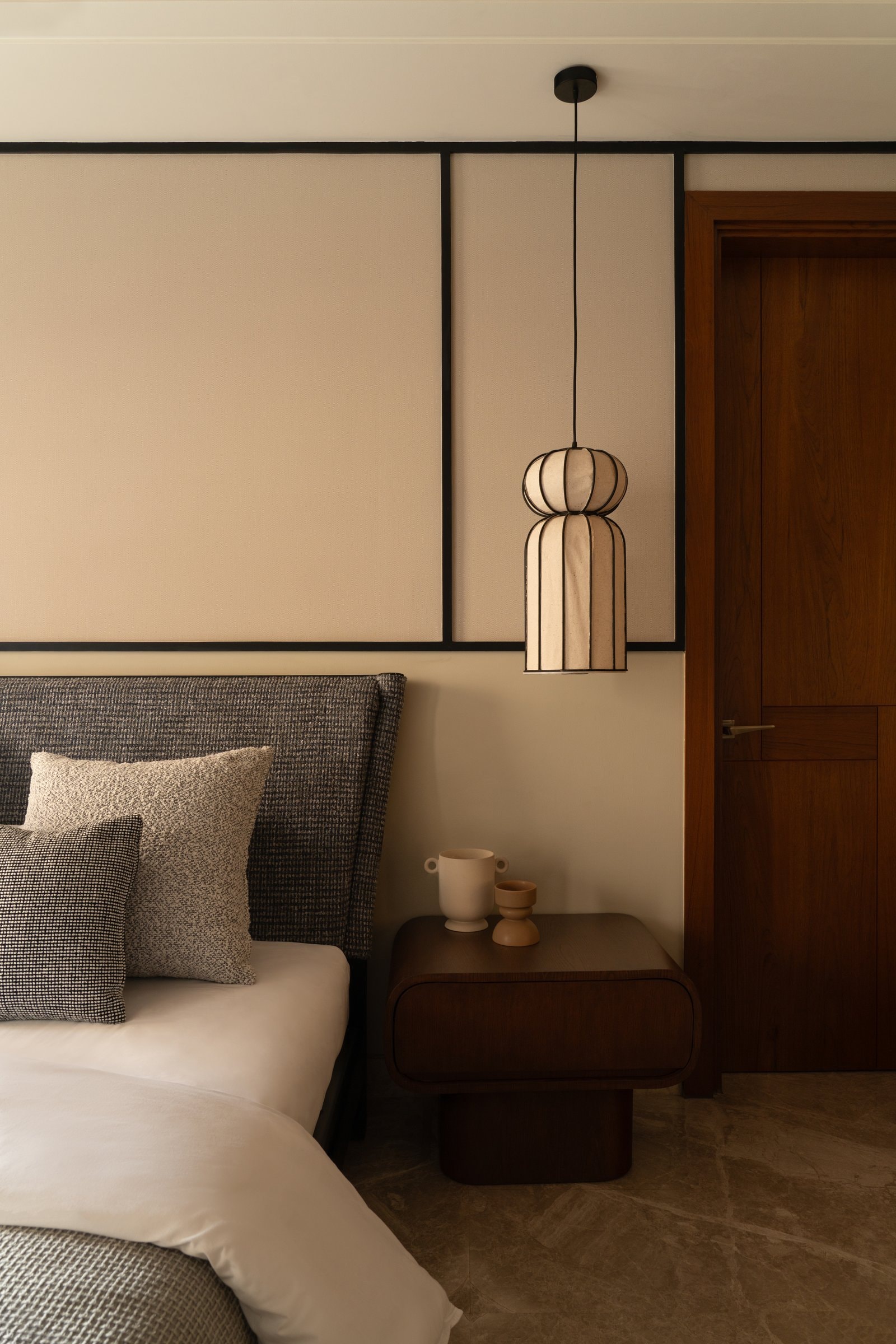
A second bedroom holds the home’s larger restraint but introduces an upholstered wall divided by slim black framing, against which a single fabric pendant in segmented form descends beside the bed. The dark wooden side table and door, paired with a tweedy upholstered headboard, allow the room to feel collected rather than designed, with the lantern-like pendant carrying the room’s expressive weight.
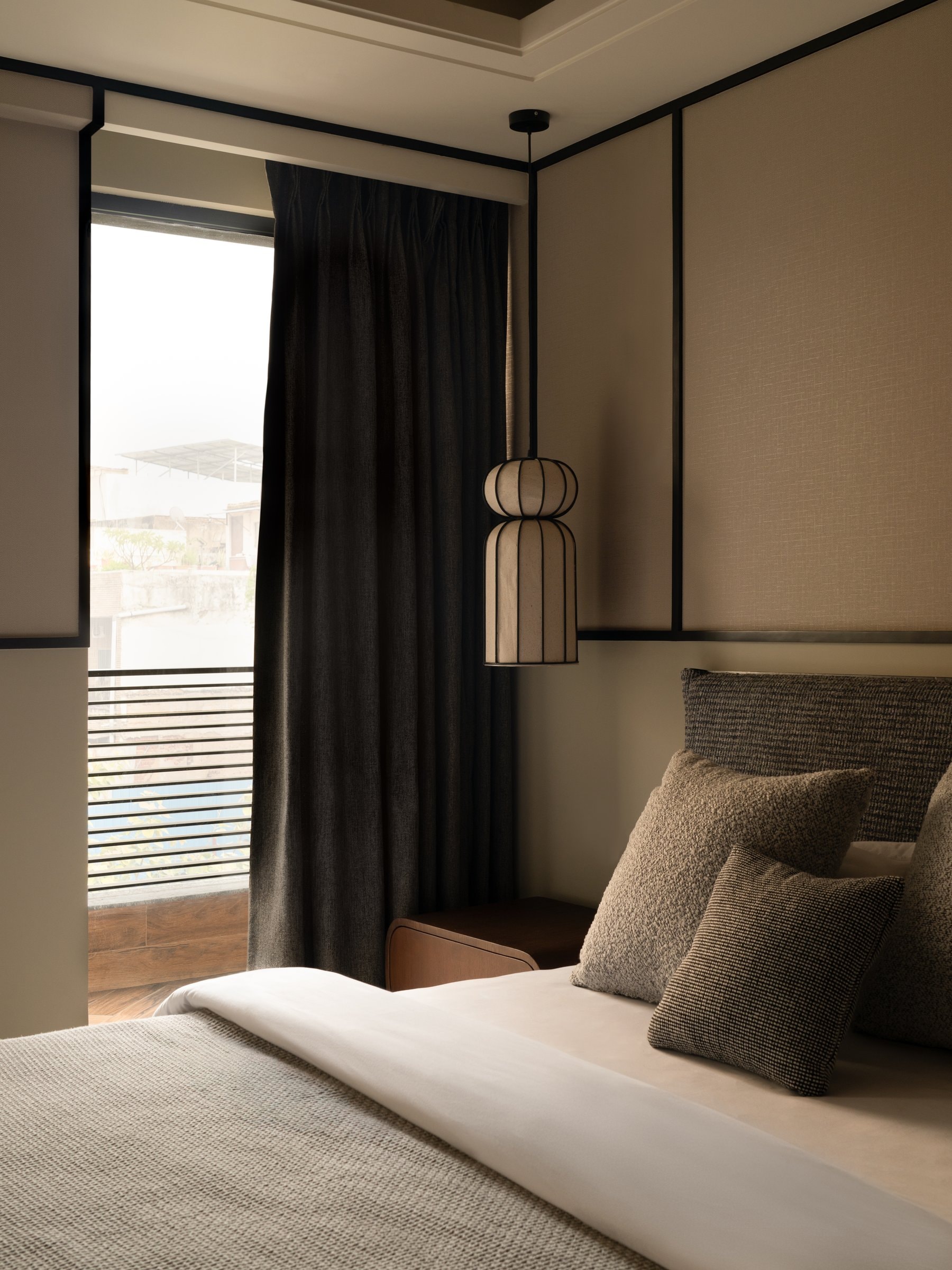
The same bedroom opens to a balcony through floor-to-ceiling glazing dressed in pleated dark drapery, the framed upholstered panelling continuing around the corner to wrap the bed. Daylight enters in a single soft column along one edge, balancing the room’s otherwise enveloping palette.

Behind the project is Nikita Jain, whose practice IndiHaus Design has built its sensibility around scale, material expression and an interest in reframing the everyday domestic plan as something more architectural. Residence 222 reads as a statement of that approach, where the act of hosting becomes a spatial argument rather than a styling exercise.
The project contributes to a broader shift in Delhi’s residential interiors, away from the polished neutrality that has defined much of the city’s apartment work and towards a more sculptural, material-led register that draws on classical motifs without literal historicism. The black columns and arches here are not nostalgic; they are structural devices, used to compose and frame views rather than to evoke a period.
What Residence 222 ultimately proposes is a home in which architecture and atmosphere arrive together. The plan is generous, the gestures are few, and the rooms are calibrated to hold both intimate evenings and larger gatherings without rearranging their character to do so.