Architecture is rarely permitted to behave like sculpture inside the constraints of a Mumbai apartment. The discipline of plan, the tyranny of the floor plate, the demands of daily function, all of these tend to flatten ambition into a familiar grammar of neutral surfaces and resolved corners. The Sculpt House proposes an alternative: that form itself can carry the entire design argument, that walls can be carved rather than built, and that a residence can adapt to its inhabitants the way a living object responds to touch.
Designed by Rohit Jain Design Studio, the Mumbai residence reads as a sequence of sculpted moments rather than a catalogue of rooms. Each space resolves around a single expressive gesture, a carved door, a transformable partition, a column reimagined as mandir, a poured-glass table, and the material palette shifts in register from one zone to the next, allowing each composition to be felt on its own terms. The result is a home that feels less decorated than choreographed.
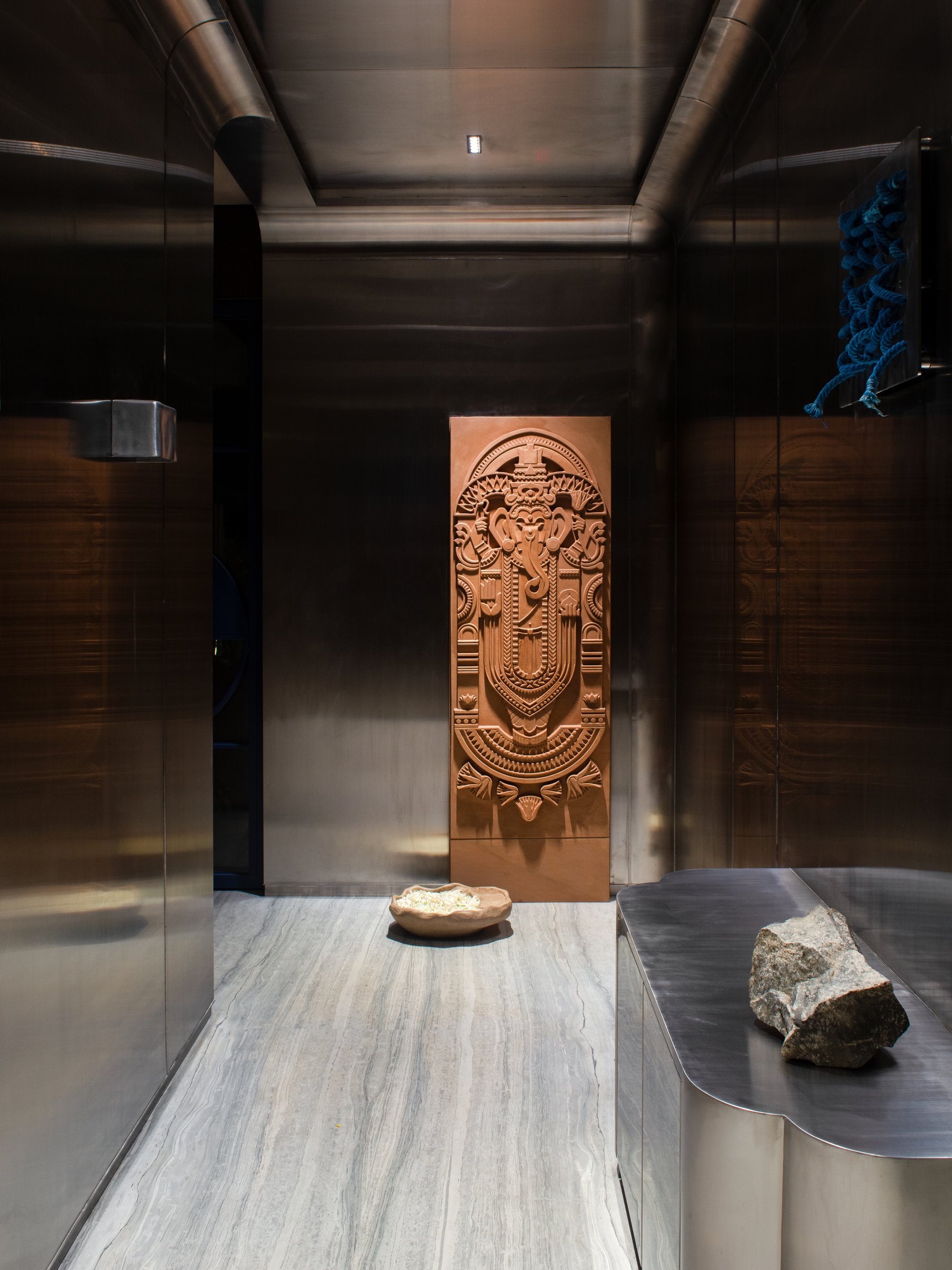
The entry sets the tone with deliberate weight. Bronzed metallic walls wrap the threshold in a low, reflective hush, framing a single carved copper-toned door panel depicting a deity figure rendered in deep relief. A pale stone floor runs through the centre.
The composition operates as both arrival and invocation. Rather than announce the apartment, the foyer slows the visitor, asking them to register material, weight, and ornament before stepping into the lighter volumes beyond.
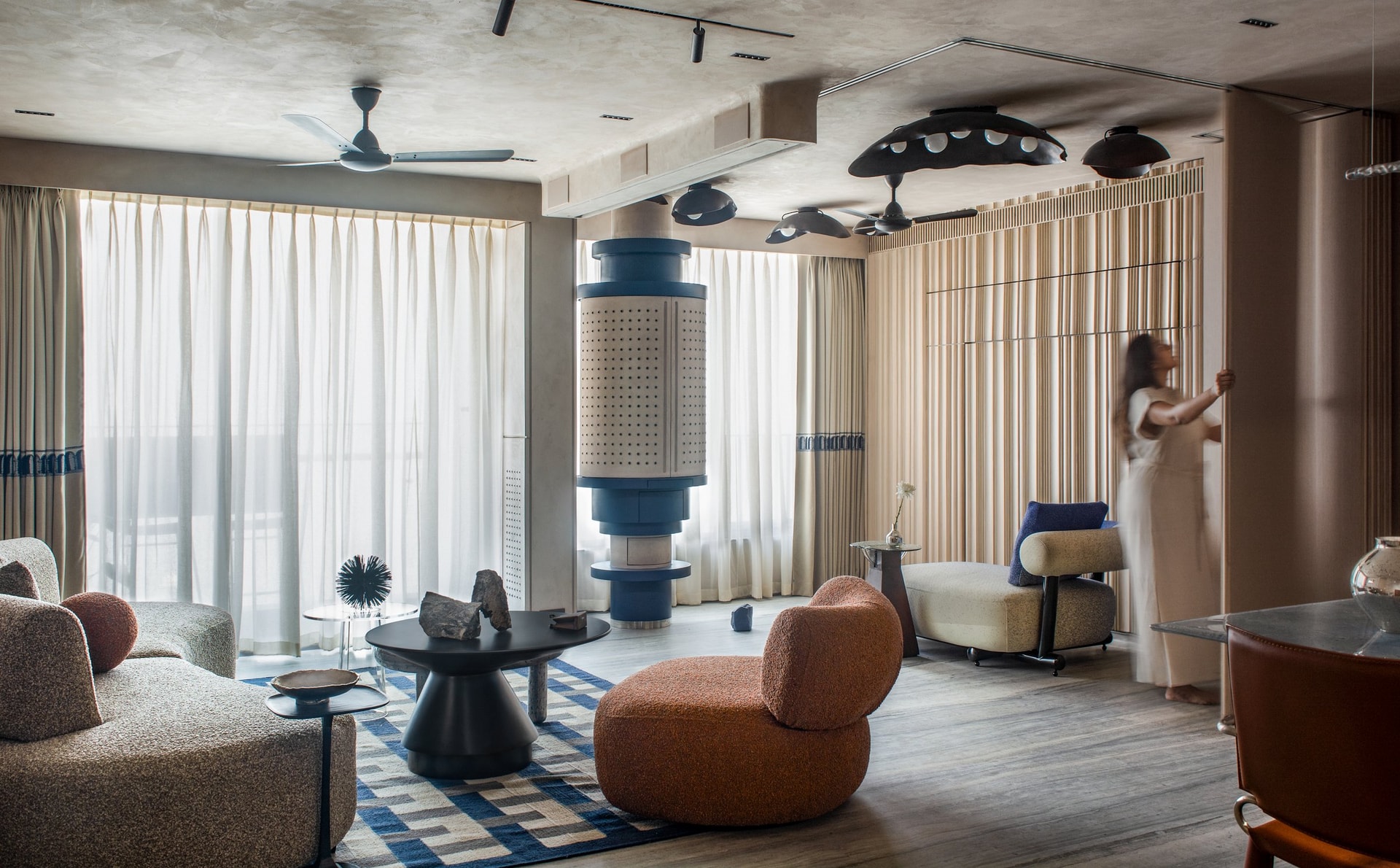
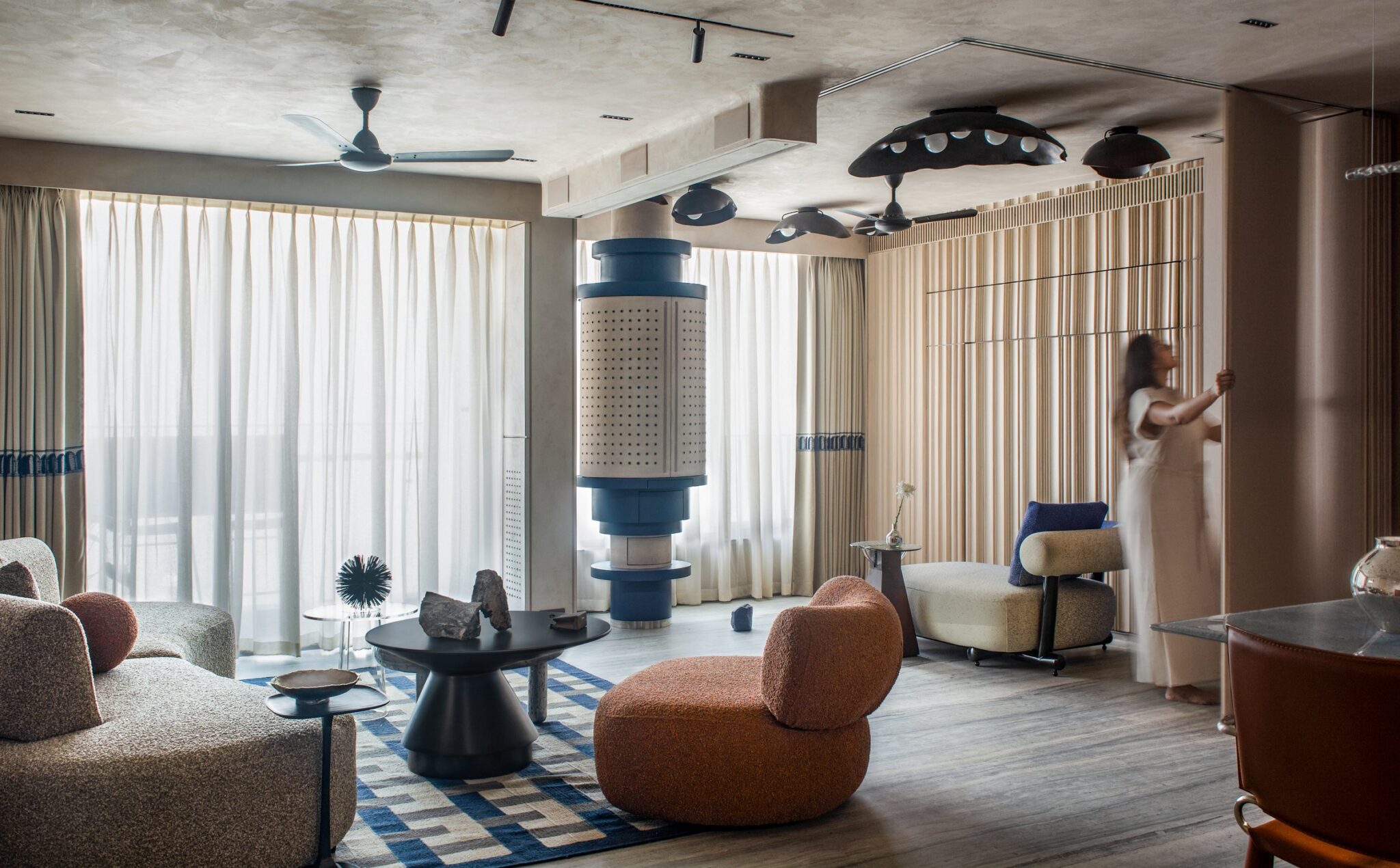
The living room opens to a different temperature altogether. Daylight pours through full-height sheers, and a perforated cylindrical column finished in pale tone and deep blue rises through the centre of the room, the structural element reframed as sculpture, neither concealed nor apologised for. A reeded screen wall slides open along one edge, the transformable partition that allows the room to expand into adjacent zones or close down into a more intimate volume.
Boucle seating in oatmeal and burnt orange gathers around a low black pedestal table, and an arrangement of dark ceiling fixtures hovers overhead like a small constellation. The geometry is composed but never resolved into symmetry; each piece holds its own silhouette.
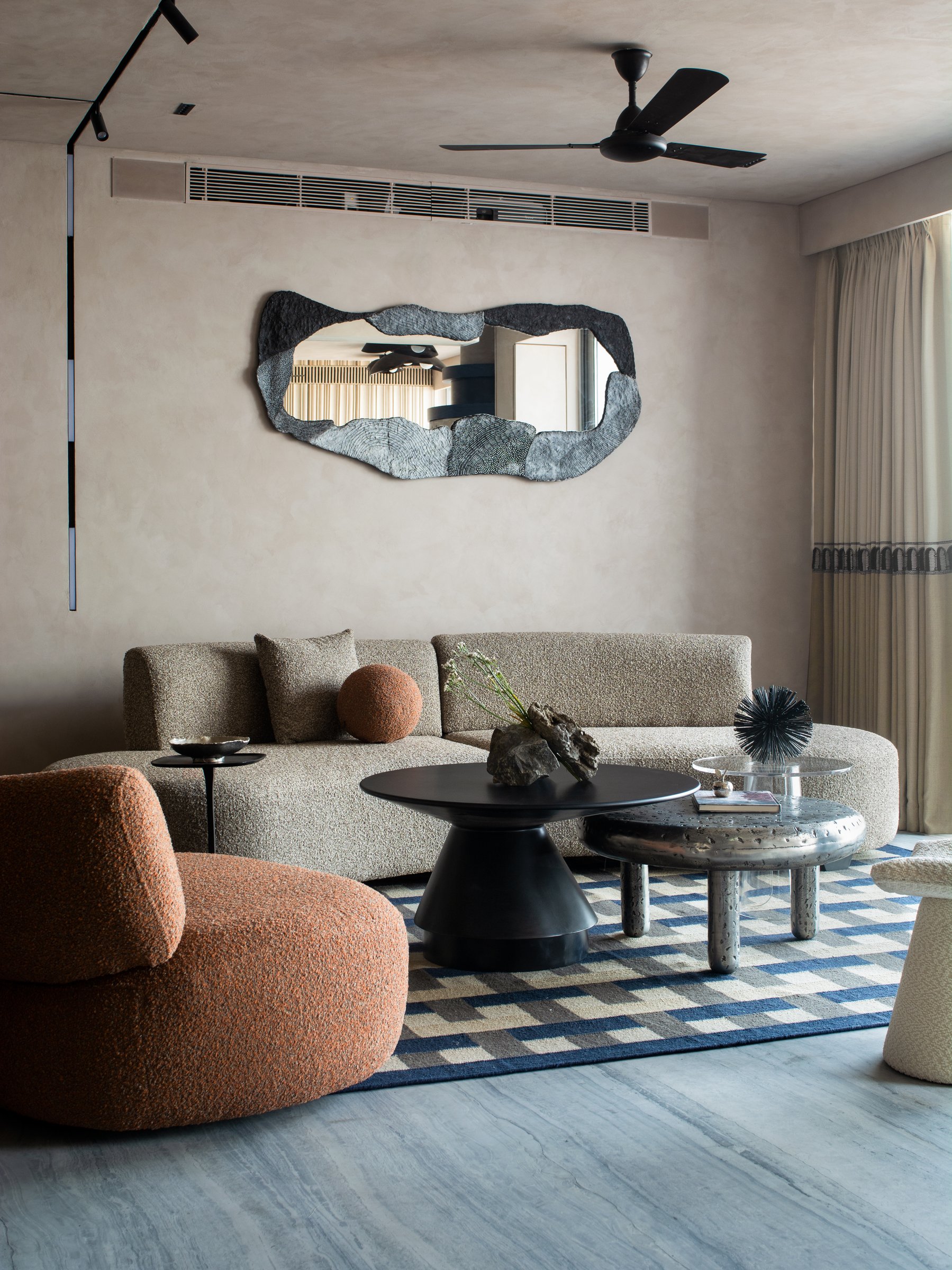
““The form itself becomes the main design idea, not just a decoration. The house behaves like a living sculpture that adapts to the user.””
A closer view of the seating arrangement reveals how carefully the room balances soft and hard. The curved boucle sofa in warm neutral is anchored by a rounded burnt-orange chair, and the coffee tables, one a black pedestal, the other a textured metallic drum on stubby legs, sit on a geometric rug patterned in blue, cream, and grey. Above the sofa, an irregularly framed mirror with a sculpted dark border reads as artwork rather than utility.
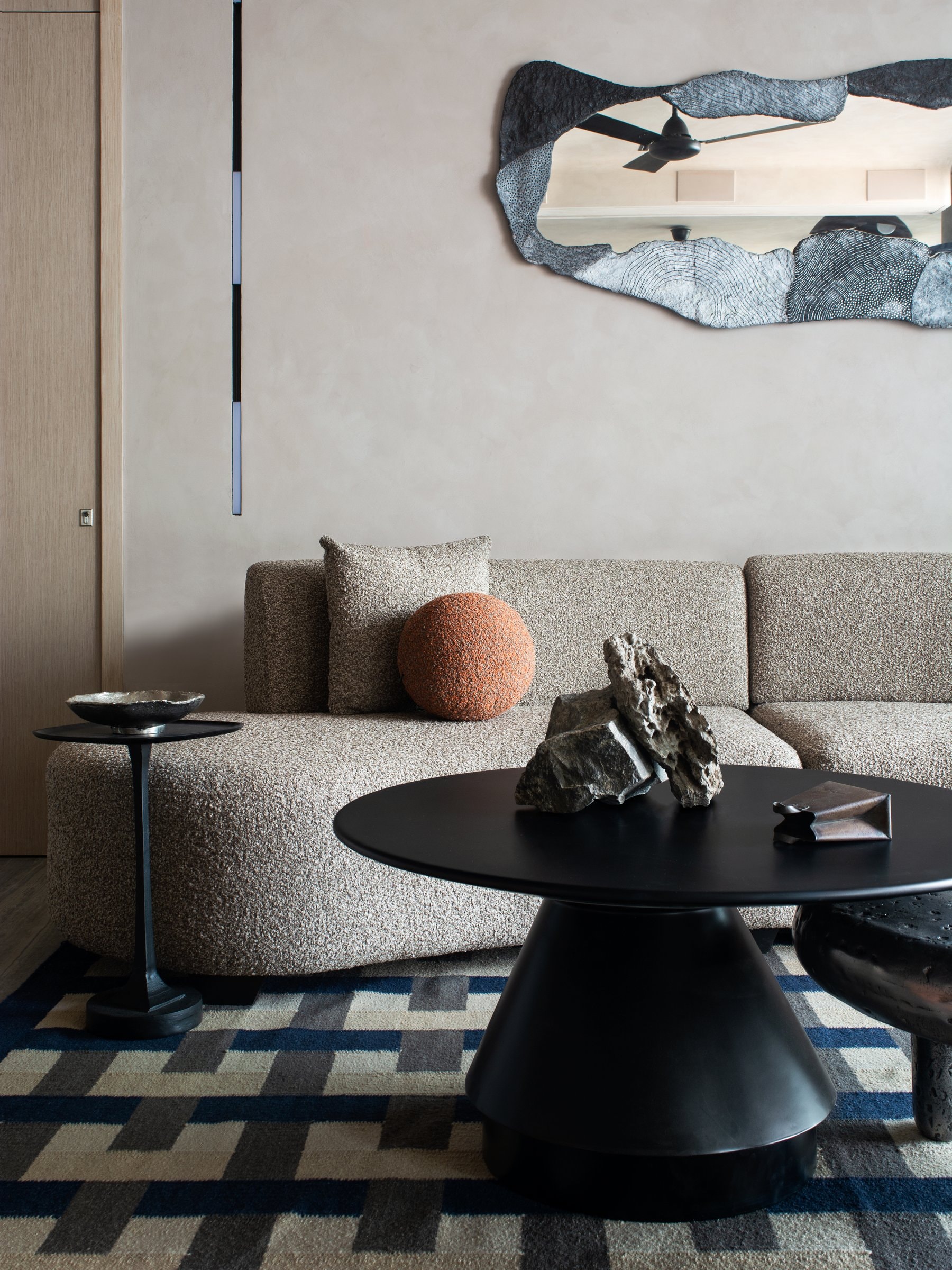
Detail closes in on the seating composition. The sculpted mirror frame, with its layered relief, sits in conversation with the cluster of raw mineral specimens on the black pedestal table, both gestures toward the same idea, that the room treats objects as carved rather than placed. The plastered wall behind, in its quiet plaster finish, lets these heavier elements register without competition.
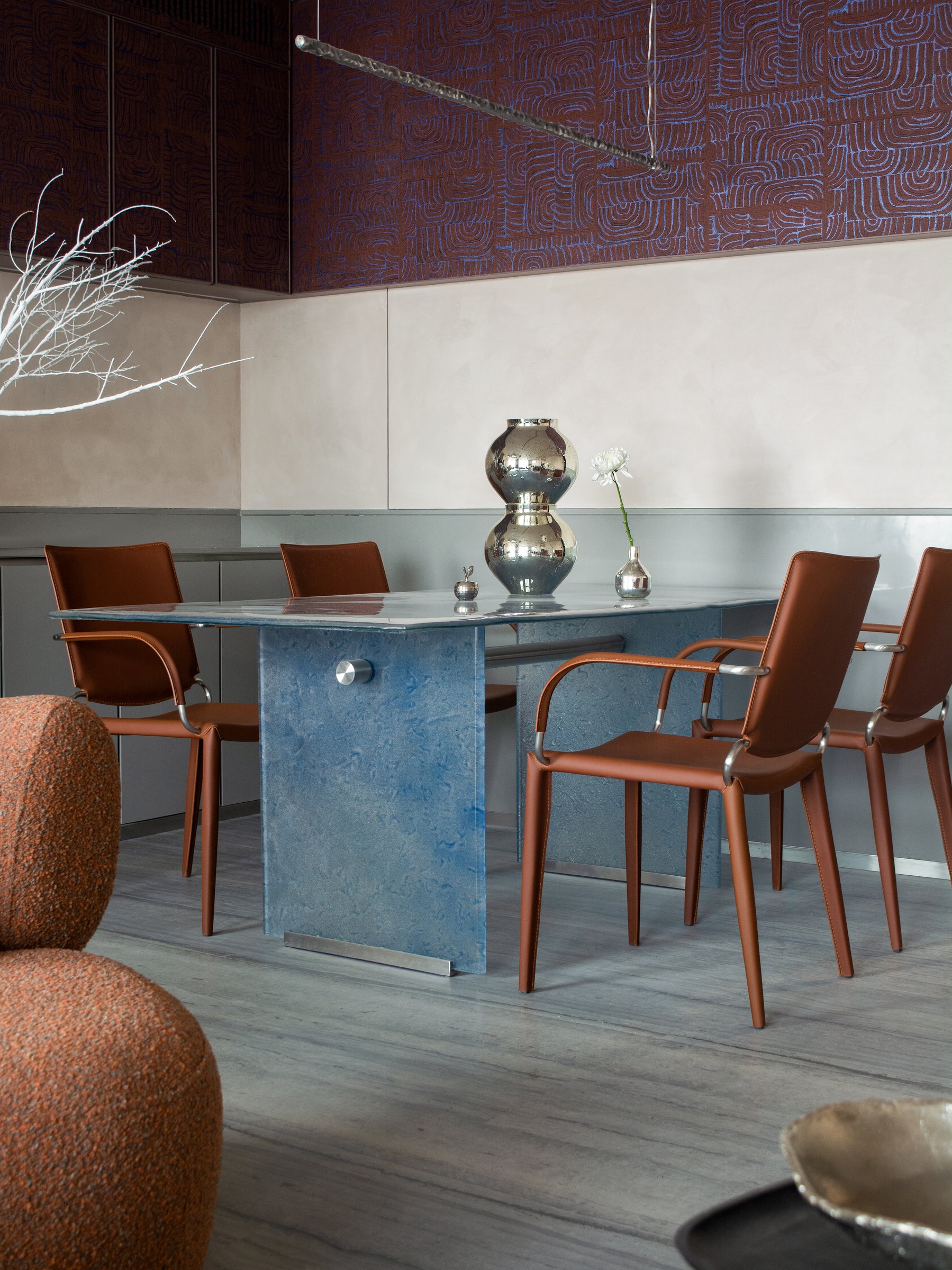
The dining area arrives as the home’s most monolithic gesture. A pale blue stone-textured table, its slab top and full-height supports rendered as a single sculptural object, anchors the room. Tan leather chairs with steel armatures circle it, and a hammered metal pendant runs the length of the table.
The wall behind is treated as composition rather than backdrop, a panelled upper register printed with a deep oxblood and indigo pattern of swirling concentric forms, set above a pale plastered dado. The dining room demonstrates the studio’s central principle: that furniture, surface, and architecture can argue with each other and still arrive at composure.
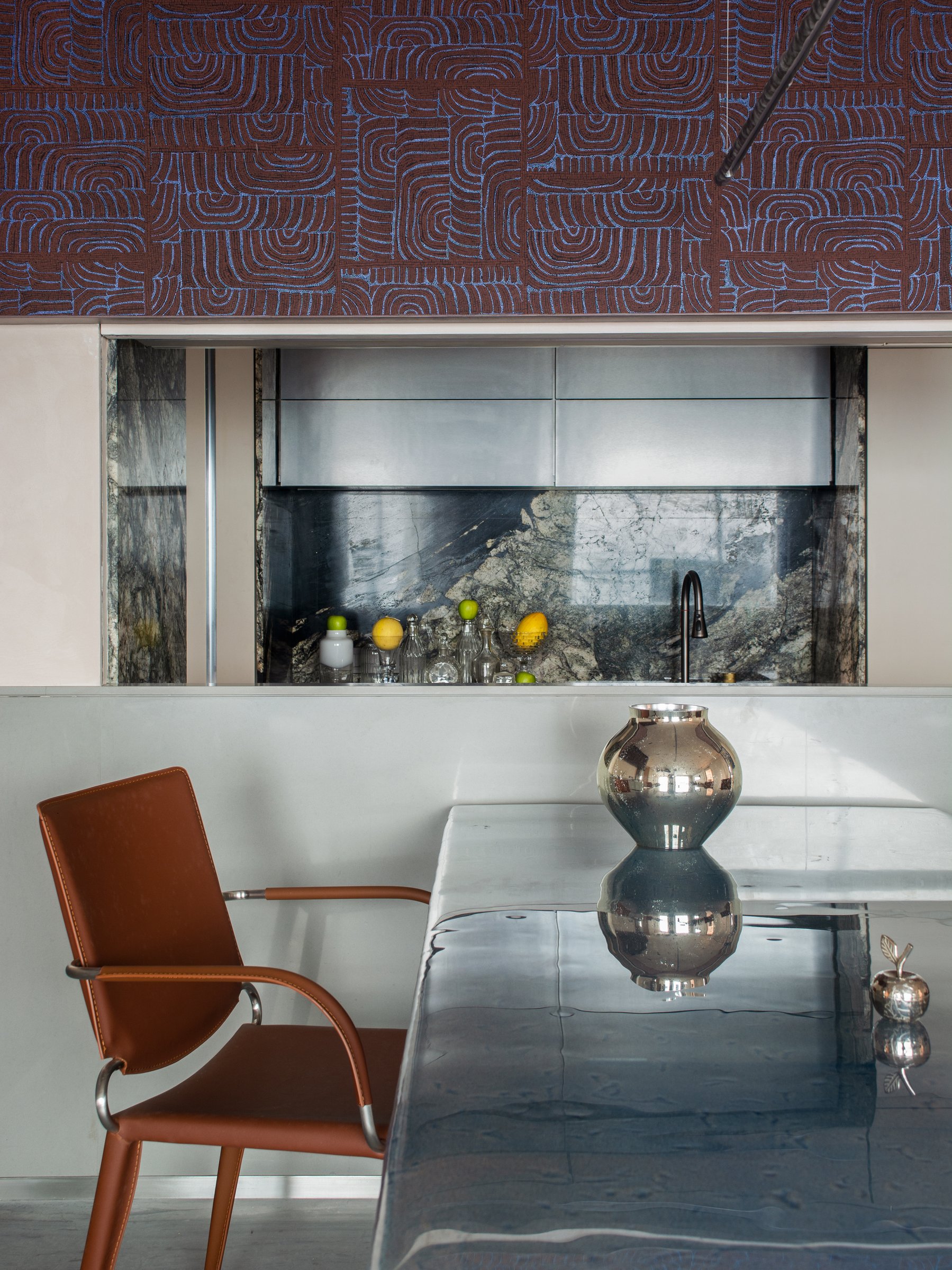
A closer view reveals how the glass tabletop catches and distorts the light, its surface registering as fluid even at rest. The patterned panelling above frames a pass-through opening to the kitchen beyond, where veined dark stone forms a backsplash and shelf, populated with glassware and citrus. The pass-through is itself a sculpted aperture, not simply a service window.
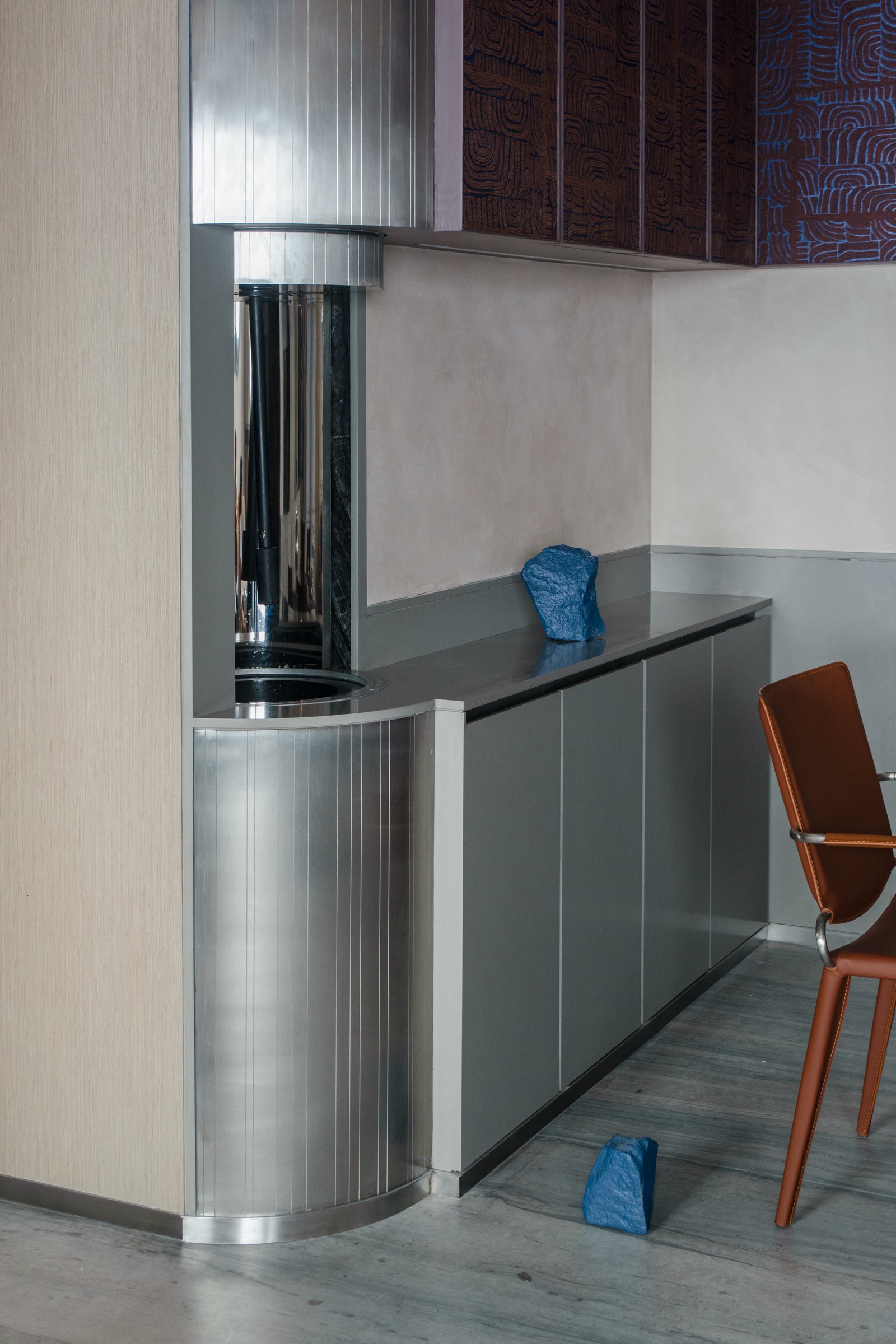
To one side of the dining zone, a service spine in grey lacquered cabinetry meets a fluted metallic column that wraps a structural element. The cylindrical insert reads as both functional and ornamental, its reflective interior set against the matte cabinetry beside it.
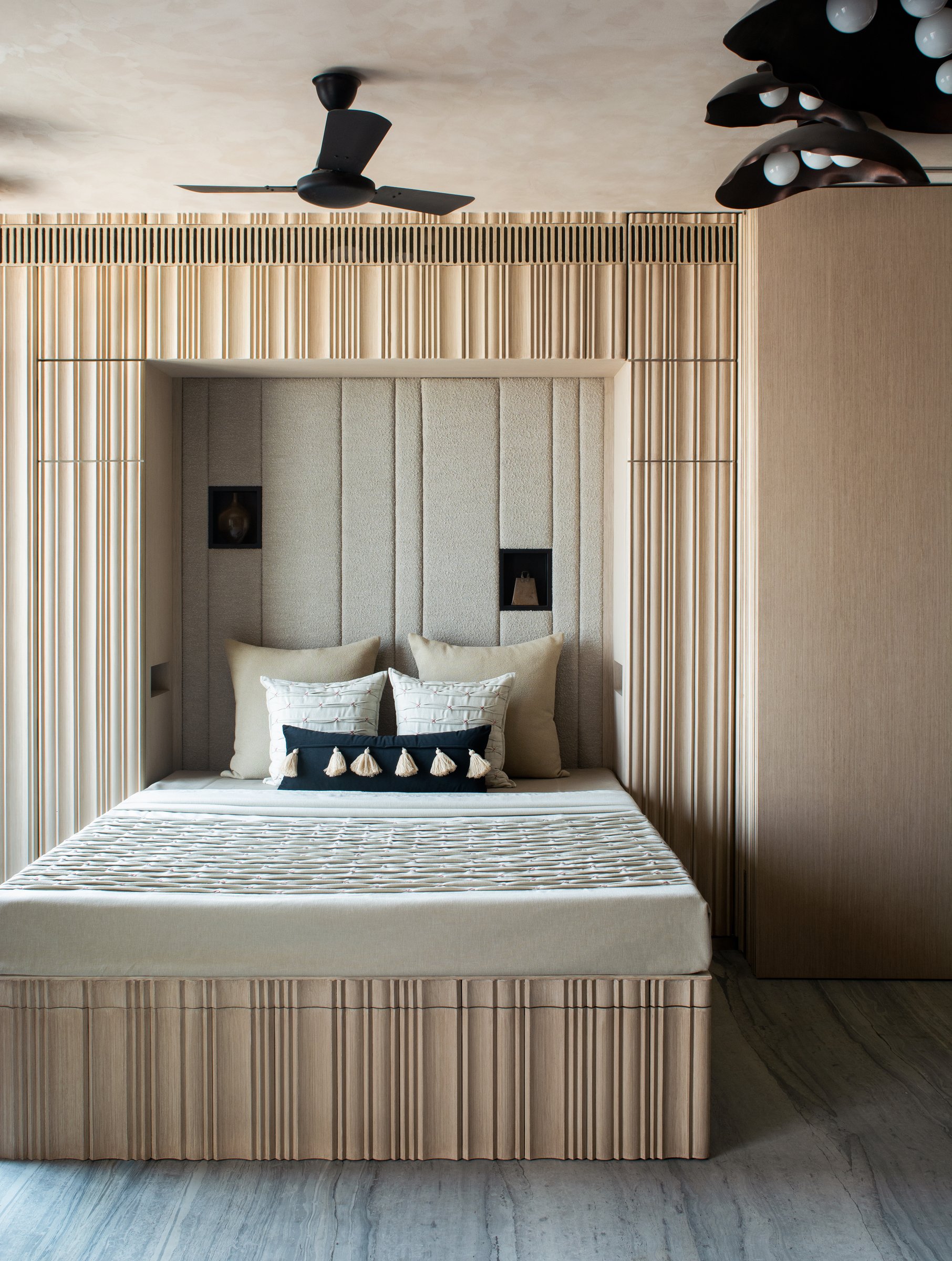
The first bedroom retreats into a calmer register. The bed sits within a deeply recessed alcove framed on three sides by fluted vertical millwork in pale wood-grain, the channels carrying upward into a slatted cornice. The upholstered headboard panel, in soft neutral, is broken by two small recessed niches that hold a single object each, restraint as composition.
Overhead, a sculptural dark pendant studded with white globes hovers like an asymmetrical cloud. The room reads as composed rather than sparse, sculpted rather than ornamented.
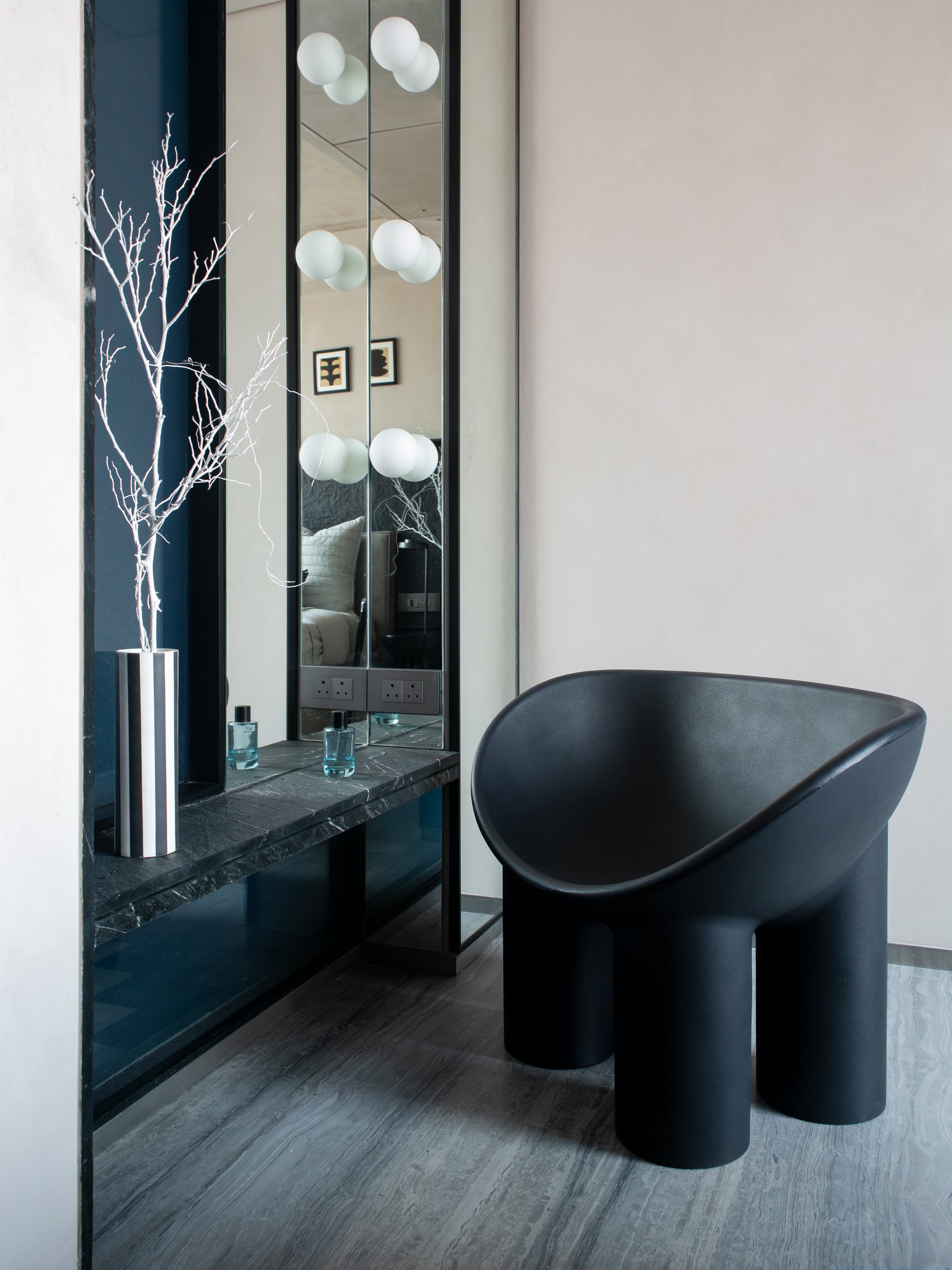
An adjacent dressing corner extends the bedroom’s quieter logic. A dark stone counter, mounted between mirrored vertical panels and a black moulded chair on four cylindrical legs anchors the floor.
The composition is small in scale but architecturally precise, treating a transitional moment as worth designing rather than absorbing into joinery.
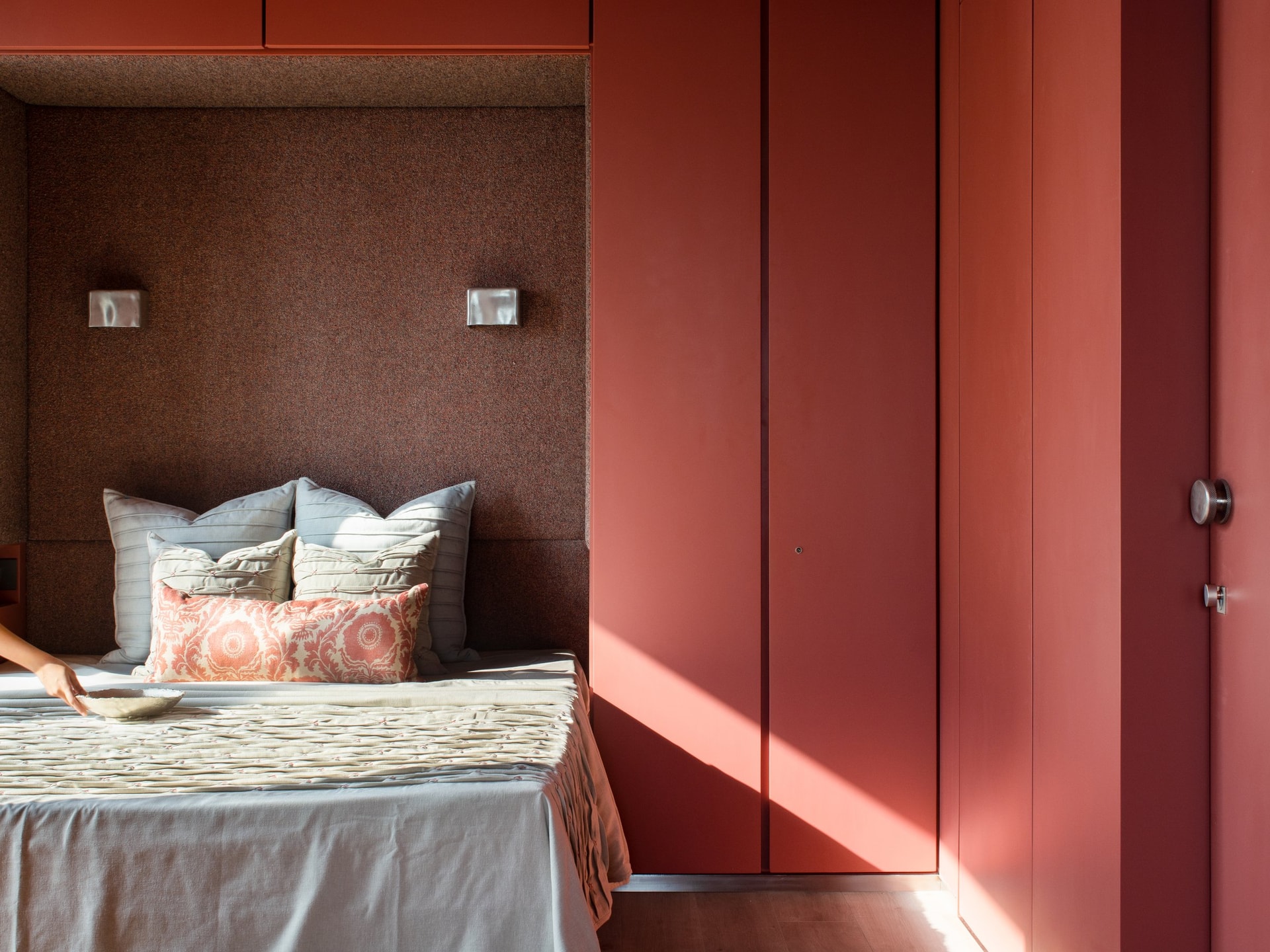
A second bedroom takes the opposite approach. Saturated terracotta envelops the room, wardrobes, doors, headboard wall, broken only by a textured pinboard panel above the bed that reads as a tonal counterpoint to the painted joinery. Late sunlight rakes across the surfaces, revealing the slight variation in finish between matte panel and lacquered door.
The chromatic confidence is the point: where other rooms in the home are sculpted through form, this one is sculpted through colour.
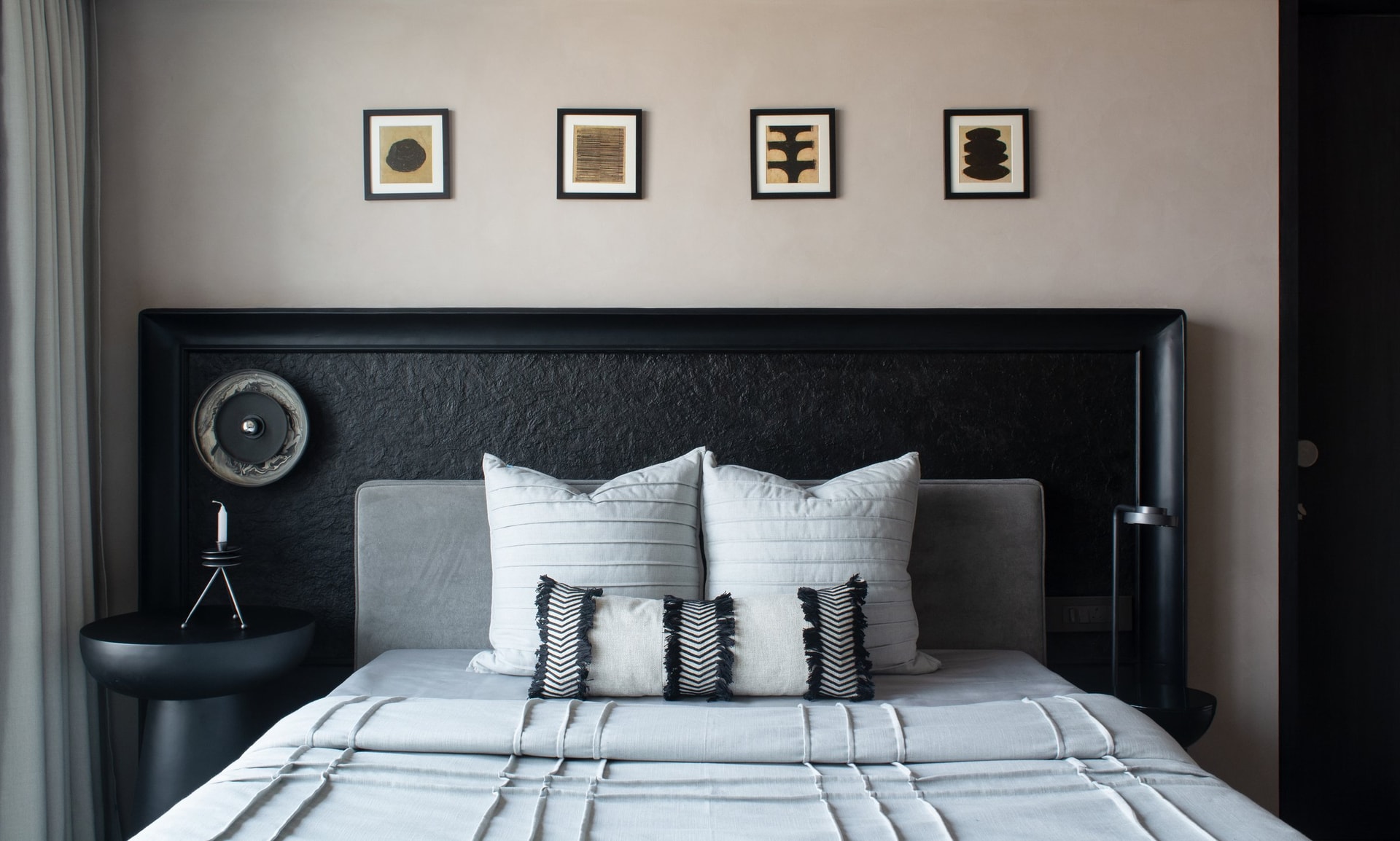
Another bedroom shifts again. A dark framed headboard with a textured black inset anchors the bed, flanked by a sculptural sconce and a slim black side table carrying a candleholder. Above, four small framed works in muted gold and black hang in a precise horizontal row, each composition reading as a sculptural fragment rather than illustration.
The room demonstrates the studio’s range, that the same design intelligence that produced the saturated terracotta room can also produce this quieter, more architectural composition.
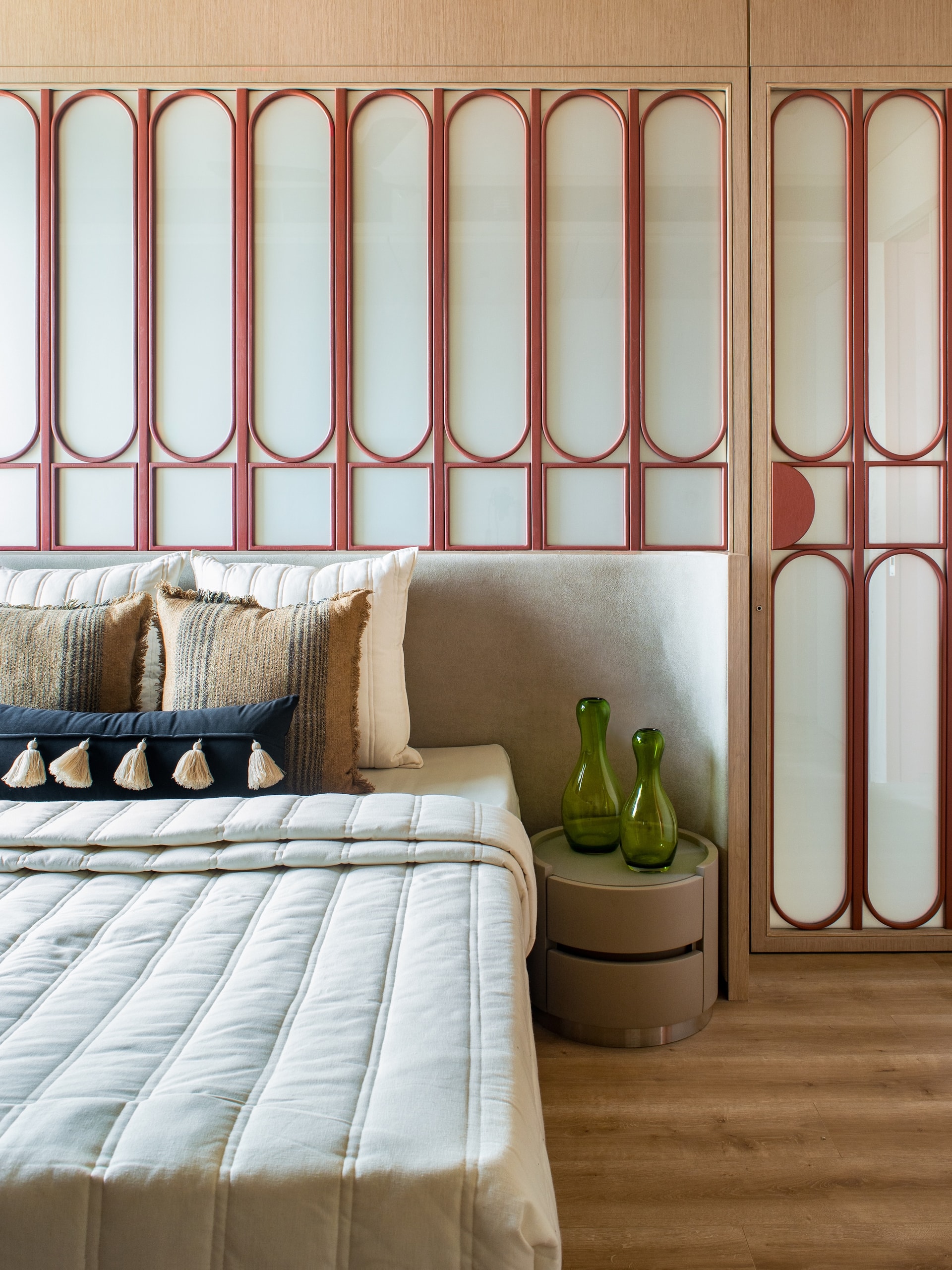
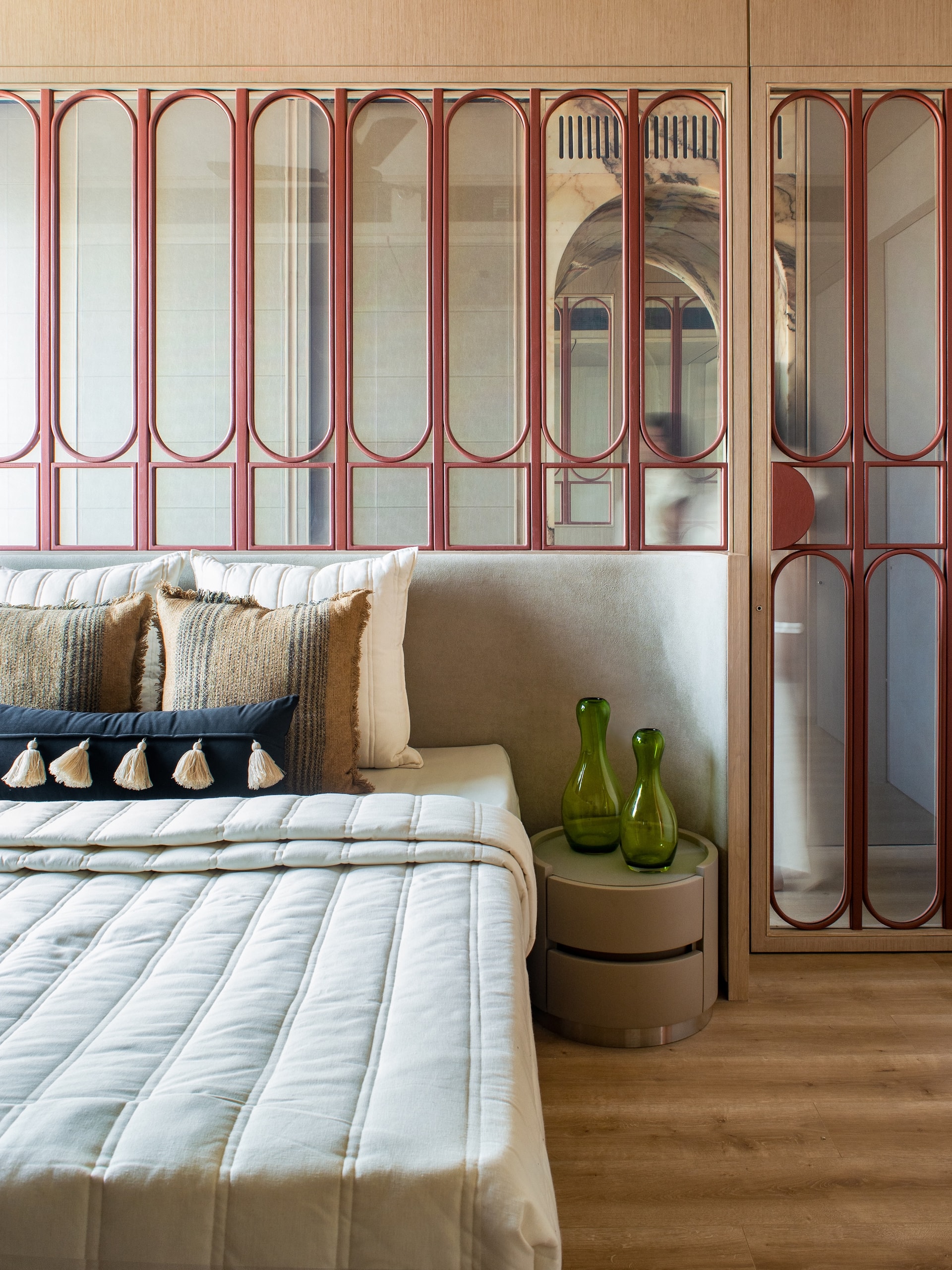
A further bedroom introduces a screen of arched terracotta-toned mullions set against frosted glass, a graphic element that operates as headboard wall and partition in a single move. The bed below is upholstered in pale neutral and dressed in cream layers, with a cylindrical bedside drum in muted tone.
The arched grille recalls a familiar architectural language without quoting it directly, its rhythm setting the tempo for the room.
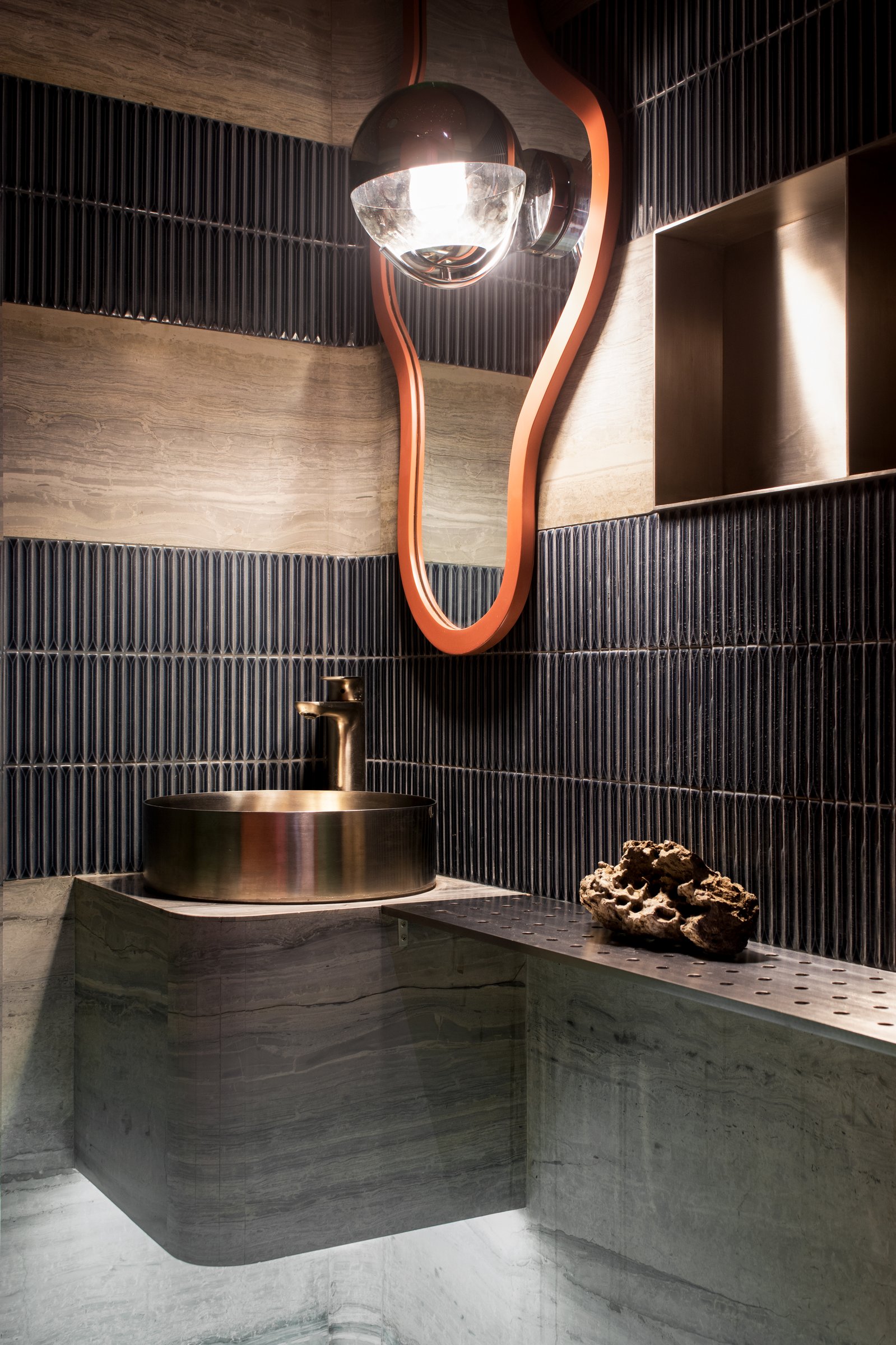
The powder room is at once the home’s most playful aside and its most ornamented expression. Slim ribbed dark tiles wrap the walls, interrupted by a continuous band of warm veined stone that folds into both shelf and counter. Above it, a wavy orange-framed mirror hovers over a brass vessel sink, while a globe sconce catches and diffuses the light across the compact surface palette.
It is a small room, but one that allows for a singularly expressive gesture, and the studio uses that license with precision.
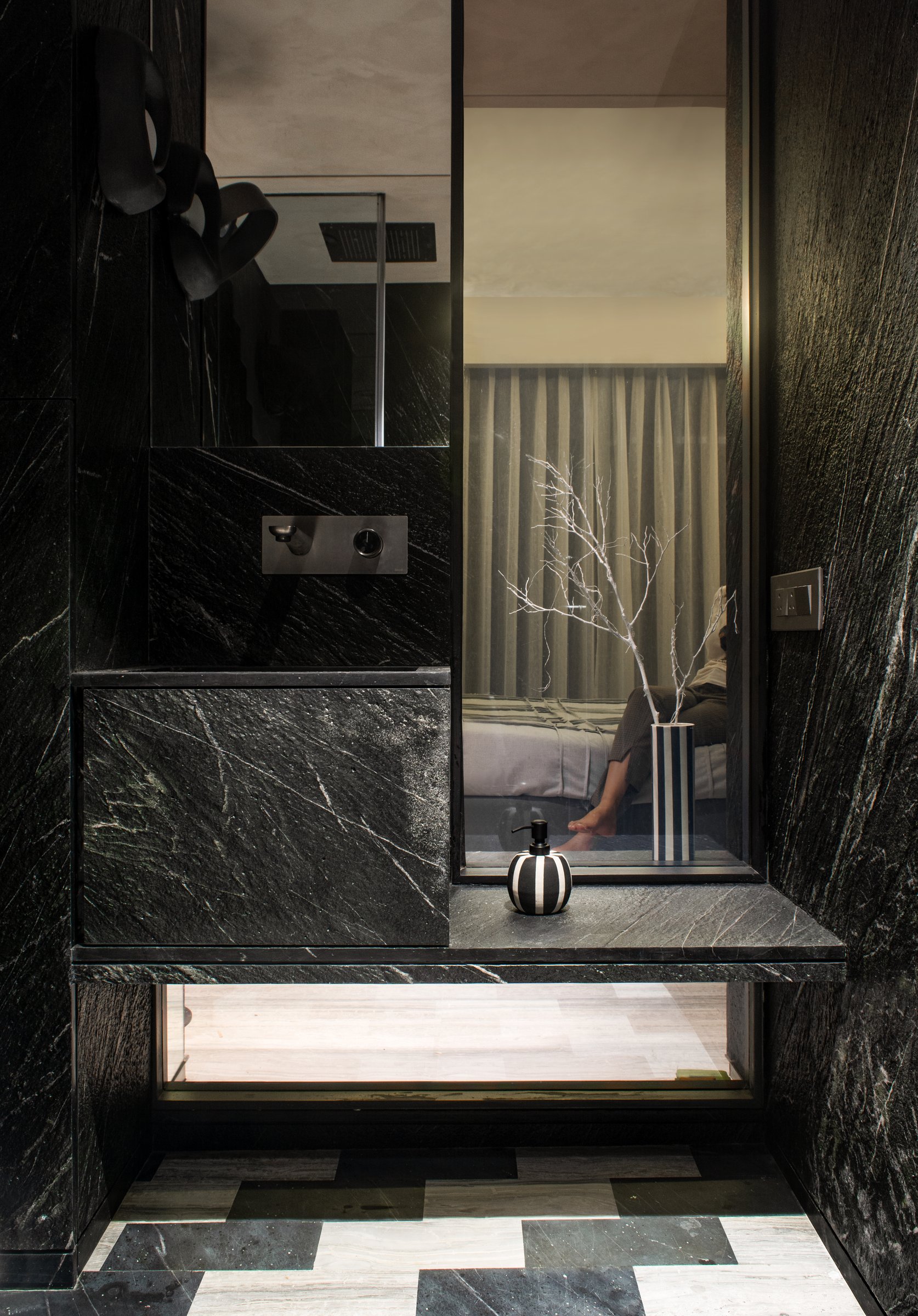
A second bathroom moves into darker territory. Veined black stone wraps the vanity, walls, and counter, with a checkered stone floor in alternating tones grounding the composition.
The Sculpt House sits within a broader contemporary moment in Mumbai residential design, where the apartment is being asked to do more than house, to express, to adapt, to register the temperament of those who live within it. Rohit Jain Design Studio’s contribution to that conversation is to insist that form itself, sculpted and confident, can carry the cultural argument without leaning on either heritage motif or imported neutrality.
What remains, walking through, is the sense of a home that has been carved rather than assembled. Each room arrives with its own register and its own confidence, and the residence as a whole reads as a sequence of considered objects rather than a single resolved interior. The proposition is quiet but decisive: that architecture, even within the constraints of an apartment, can behave like sculpture and still feel like home.